
Have you ever wondered if your marketing data is disappearing right before your eyes as privacy regulations tighten across the United States? As browsers phase out traditional methods, many businesses struggle to maintain visibility over their performance metrics.
The good news is that cookieless affiliate tracking offers a robust path forward. By shifting your strategy, you can measure success without relying on outdated third-party tools.
Modern attribution now leverages first-party identifiers, server-side events, and authenticated customer data to bridge the gap. You can also utilize URL parameters and unique promo codes to ensure every conversion is accounted for accurately.
This guide will help you select, build, and test a privacy-conscious measurement system. You will learn how to improve your data accuracy while respecting user privacy in an evolving digital landscape.
Key Takeaways
- Understand why traditional third-party methods are becoming obsolete for modern marketers.
- Learn how to implement first-party identifiers to maintain data integrity.
- Discover the power of server-side events for more reliable conversion reporting.
- Utilize promo codes and URL parameters as effective alternatives for attribution.
- Build a future-proof strategy that prioritizes both user privacy and performance insights.
Build a Future-Proof Tracking Strategy
Stop losing valuable attribution data as privacy rules and browser restrictions evolve. Discover practical cookieless tracking methods that protect performance, privacy, and revenue.
Why Cookieless Affiliate Tracking Matters for Affiliate Growth
The landscape of online tracking is shifting rapidly, forcing brands to rethink their data strategies. As privacy regulations tighten, the traditional methods you once relied on are becoming less effective. Adapting your cookieless affiliate tracking technology is no longer optional; it is a fundamental requirement for sustainable growth.
How browser privacy changes affect affiliate attribution
Modern web browsers now implement strict limitations on how data is stored and shared. These changes often interrupt the seamless path between an affiliate click and a completed conversion. When scripts are blocked or consent is withheld, the connection between your partners and your revenue becomes fragmented.
You may find that your current setup fails to capture the full picture of user behavior. This creates gaps in your data that make it difficult to optimize your marketing spend. Without a robust strategy, you risk losing visibility into which partners are actually driving your business forward.
Why third-party cookies are becoming unreliable
Third-party cookies are controlled by external domains, making them inherently less dependable than direct signals. Because these cookies exist outside your own website, they are frequently flagged or deleted by privacy-focused browser settings. This lack of control leaves your attribution data vulnerable to external policy changes.
In contrast, first-party or server-based signals allow you to maintain ownership of your data. This is where cookieless affiliate tracking provides a more stable foundation. By moving away from reliance on third-party scripts, you gain a more stable foundation for your analytics. This shift ensures that your tracking technology remains functional even as industry standards evolve.
What accurate cookieless measurement helps you protect
Implementing precise measurement is about more than just numbers; it is about protecting the integrity of your entire affiliate ecosystem. Accurate data ensures that your partners receive fair commissions, which strengthens your long-term relationships. When you can prove the value of every referral, you build trust that encourages affiliates to invest more in your brand.
Furthermore, reliable data allows you to manage your marketing budgets with confidence. You can identify high-performing channels and cut waste, directly impacting your bottom line. Ultimately, modern cookieless affiliate tracking technology helps you respect customer privacy while maintaining the transparency needed to scale your revenue effectively.
How Cookieless Affiliate Tracking Works
The mechanics of cookieless tracking affiliate systems rely on a seamless flow of data from the initial click to the final sale. By moving away from third-party dependencies, you gain more control over your data while respecting user privacy. This approach ensures that your marketing efforts remain measurable even as browser standards evolve.
First-party identifiers and direct relationships with your visitors
When a visitor arrives at your site, you can establish a direct relationship by using first-party identifiers. Unlike third-party cookies that are often blocked, these identifiers are set by your own domain. This allows you to store attribution data securely within your own site-owned storage.
By keeping this data under your control, you ensure that the information remains accessible throughout the user session. This is a core benefit of cookieless affiliate tracking. This method builds a foundation for reliable attribution that does not depend on external tracking scripts or cross-site data sharing.
Server-side tracking and conversion data transmission
Server-side tracking represents a significant upgrade in how you handle conversion data. Instead of relying on the user’s browser to report a sale, your server sends the data directly to the affiliate platform. This process is highly effective for a cookieless tracking affiliate strategy because it bypasses browser-level restrictions.
- Your server captures the conversion event in real-time.
- The data is transmitted securely to the affiliate network’s API.
- The network validates the transaction and updates the partner’s dashboard.
Click IDs, affiliate IDs, and other attribution signals
Attribution signals are the backbone of your cookieless affiliate tracking setup. When a user clicks an affiliate link, unique parameters such as a Click ID or an Affiliate ID are passed through the URL. These signals act as a digital fingerprint for the referral.
You should capture these parameters immediately upon landing. By storing them in your database or a first-party cookie, you ensure that the referral source is preserved even if the user navigates across multiple pages before completing a purchase.
How the tracking journey connects a click to a conversion
The journey from a click to a conversion follows a structured path that ensures no data is lost. This cookieless affiliate tracking journey follows a structured path. By mapping this process, you can identify exactly where your cookieless tracking affiliate setup needs to be most robust.
- Click Capture: The user clicks a link containing unique identifiers.
- Landing Page Storage: Your site captures and stores these IDs in first-party storage.
- Checkout Submission: The user completes a purchase, and your system associates the stored IDs with the transaction.
- Server-Side Reporting: Your server sends the conversion details to the affiliate platform for final validation.
Cookieless Affiliate Tracking Methods You Can Use
Implementing effective cookieless affiliate tracking is essential for businesses looking to sustain growth in a privacy-first digital landscape. As third-party cookies fade, you must adopt a multi-layered approach to ensure your conversion data remains accurate and actionable.
First-party cookies and site-owned storage
First-party cookies are set directly by your domain, making them far more resilient than their third-party counterparts. This makes them an important component of cookieless affiliate tracking. By utilizing site-owned storage, such as local storage or session storage, you can persist affiliate identifiers across a user’s journey on your website without triggering privacy blocks.
Server-to-server postback tracking
Server-to-server (S2S) postback tracking is widely considered the gold standard for reliability. Instead of relying on browser-side scripts, your server communicates directly with the affiliate network’s server to confirm a conversion. This method ensures that your cookieless affiliate tracking remains immune to ad blockers and browser restrictions.
“The shift toward server-side integration is not just a technical upgrade; it is a fundamental requirement for maintaining data integrity in an era of increased privacy regulation.”
URL parameters and link decoration
Link decoration involves appending unique identifiers to your landing page URLs. This approach supports reliable cookieless affiliate tracking. When a user clicks an affiliate link, these parameters such as a Click ID—are captured by your site and stored in your database. This allows you to map a specific click to a later conversion event seamlessly.
Authenticated and account-based attribution
If your business model involves user accounts, you can leverage authenticated attribution. By linking an affiliate ID to a user profile upon registration or login, you can track conversions across multiple devices and sessions. This method is highly effective for SaaS platforms and subscription-based services.
Promo codes and offer-specific tracking
Sometimes, the simplest cookieless affiliate tracking solution is the most effective. Using unique promo codes allows you to attribute sales to specific partners even when digital tracking signals are lost. This approach is particularly useful for influencers and offline marketing efforts where direct link tracking may fail.
Consent-based tracking with privacy controls
Integrating cookieless affiliate tracking with a robust consent management platform ensures you remain compliant with global privacy laws. By respecting user opt-outs while still capturing anonymized conversion data, you balance performance with ethical data practices.
| Method | Best For | Reliability |
|---|---|---|
| Server-to-Server | High-volume e-commerce | Very High |
| First-party Storage | General web traffic | Medium |
| Promo Codes | Influencer marketing | High |
| Authenticated | SaaS/Subscriptions | Very High |
Choosing the right combination of these methods depends on your technical resources and your specific sales cycle. By diversifying your tracking strategy, you protect your revenue data against the ongoing changes in browser technology.
How to Build a Cookieless Affiliate Tracking System
Creating a cookieless tracking affiliate infrastructure is essential for maintaining visibility in a privacy-first web environment. By moving away from browser-based storage, you gain greater control over your data accuracy and long-term attribution reliability.

Define the conversion events you need to measure
Start by mapping every touchpoint that signifies value for your business. You should track specific actions such as completed purchases, qualified lead submissions, new subscriptions, and even cancellations or refund requests.
Defining these events clearly ensures that your backend systems know exactly when to trigger an attribution signal. This is essential for accurate cookieless affiliate tracking. This granular approach allows you to optimize your campaigns based on actual revenue rather than just clicks.
Create consistent affiliate and click identifiers
To maintain a cookieless tracking affiliate link, you must generate unique identifiers for every partner and every click. These IDs act as the bridge between the initial referral and the final conversion event.
Consistency is vital here. Ensure these identifiers are stored in a way that persists across different sessions and devices, such as within your own database or first-party storage.
Capture attribution data on your landing pages
When a visitor arrives at your site, your landing pages must immediately capture the incoming URL parameters. This first step is critical to cookieless affiliate tracking. Use scripts to extract the affiliate ID and click ID from the query string.
Once captured, store this information in a first-party cookie or a hidden field within your session data. This helps maintain consistent cookieless affiliate tracking throughout the journey. This ensures the attribution signal remains attached to the user throughout their browsing experience.
Pass click data through checkout and lead forms
As the user moves toward a conversion, you must carry the attribution data through your forms and checkout flow. If a user fills out a lead form, ensure the hidden fields containing the click ID are submitted alongside their contact information.
For e-commerce checkouts, pass these identifiers into your order management system. This keeps your cookieless affiliate tracking data connected to the transaction. This keeps the link between the affiliate and the transaction intact until the final payment is processed.
Send conversion data from your server to the affiliate platform
Once the conversion occurs, your server should initiate a secure request to the affiliate platform. This server-to-server communication bypasses browser restrictions and ensures that your cookieless tracking affiliate data is delivered reliably.
Include transaction IDs, commission values, and conversion status
Your postback request must contain essential metadata to validate the conversion. Always include a unique transaction ID, the final commissionable value, and the current status of the order.
Providing this level of detail allows the affiliate platform to calculate accurate payouts. It also strengthens your cookieless affiliate tracking reporting It also helps you maintain transparency with your partners regarding which sales are approved or rejected.
Prevent duplicate postbacks and repeated commissions
Implement idempotency checks to ensure that a single customer action does not trigger multiple commissions. Your system should verify if a transaction ID has already been processed before sending a new request.
By checking the status of the transaction in your database, you prevent accidental double-counting. This protects your margins and ensures your reporting remains clean and trustworthy.
How to Choose the Right Tracking Technology
Implementing effective conversion measurement starts with choosing the right tracking technology for your unique infrastructure. You must balance implementation effort against the need for long-term data accuracy. By assessing your specific customer journey, you can select a solution that remains stable despite evolving privacy standards.
Strengthen Your Affiliate Attribution
Turn fragmented conversion data into reliable insights with first-party identifiers, server-side tracking, and smarter attribution methods designed for privacy-first affiliate marketing.
When first-party tracking is the practical starting point
If your business operates with a straightforward sales funnel, first-party tracking is often the most efficient choice. It can be a practical starting point for cookieless affiliate tracking. This method relies on your own domain to set identifiers, which helps maintain data continuity. It is ideal for brands that manage their own landing pages and want to avoid complex server-side configurations.
When server-side tracking provides stronger reliability
When browsers block client-side scripts or clear storage, server-side tracking becomes essential. This approach moves the data collection process to your backend, ensuring that conversion signals are sent directly to your affiliate platform. It provides superior control over data quality and is highly resistant to ad-blockers or privacy-focused browser updates.
When coupon codes or vanity URLs improve attribution
Sometimes, the most reliable way to track performance is to bypass digital signals entirely. Coupon codes and vanity URLs offer a robust fallback that works regardless of browser settings or user consent. These methods are particularly effective for influencer partnerships and social media campaigns where direct link tracking might fail.
When an affiliate network’s native cookieless tools are sufficient
Many modern affiliate networks now offer built-in solutions designed to handle privacy changes automatically. These tools can simplify cookieless affiliate tracking implementation. You should consider these native tools if you want to minimize development time and maintenance. They are often pre-configured to handle common attribution challenges, allowing you to focus on your core business goals.
How to evaluate integrations, reporting, and technical support
Selecting the right tracking technology requires a thorough review of your technical requirements. Use the following criteria to evaluate potential solutions:
- API Capabilities: Ensure the platform supports flexible data transmission for custom events.
- Testing Environments: Look for sandbox modes that allow you to validate data flow before going live.
- Reporting Detail: Verify that the dashboard provides granular insights into conversion paths.
- Technical Support: Prioritize partners that offer dedicated documentation and responsive engineering assistance.
- Integration Ease: Check if the solution connects seamlessly with your existing CRM or checkout software.
By carefully vetting these factors, you ensure that your chosen tracking technology remains a reliable asset for your affiliate program. Consistent testing and monitoring will help you maintain high data integrity as your business scales.
How to Preserve Attribution Across the Customer Journey
You must ensure that your marketing data remains intact even when customers take days or weeks to complete a purchase. Implementing cookieless affiliate tracking allows you to maintain visibility into the customer journey without relying on outdated browser storage methods. By focusing on server-side signals, you can keep your data accurate and reliable.

Maintaining click data across multiple sessions
When a user clicks an affiliate link but does not buy immediately, you need a way to store that context. Using first-party storage or server-side session identifiers ensures the data persists across different browser sessions. This approach keeps the affiliate link active even if the user clears their cache or switches browsers.
Handling cross-device and logged-in customer activity
Modern users often start their research on a mobile device and finish the purchase on a desktop. This makes cookieless affiliate tracking especially valuable for maintaining attribution across devices. By requiring users to log in, you can map their activity to a unique User ID. This identifier acts as a bridge, allowing you to attribute the final sale to the original affiliate click regardless of the device used.
Connecting affiliate clicks with lead-generation conversions
For businesses that rely on lead forms, you should pass the affiliate click ID into hidden fields within your forms. When the lead is submitted, this ID is captured in your CRM alongside the user’s contact information. This ensures that the cookieless affiliate tracking system recognizes the source when the lead eventually converts into a paying customer.
Attributing subscriptions, renewals, refunds, and cancellations
Tracking does not end at the initial sale, especially for subscription-based models. You should configure your server to send postback events for recurring billing cycles and status changes. These events can be incorporated into your cookieless affiliate tracking workflow. This transparency helps you manage commissions fairly while accounting for refunds or cancellations that might impact the final payout.
Using a defined attribution window without overstating affiliate impact
It is vital to set a realistic attribution window that matches your specific sales cycle. While long windows capture more data, they can lead to inaccurate claims that an affiliate caused a sale that happened months later. You should balance data collection with fair attribution practices to maintain trust with your partners.
| Event Type | Tracking Method | Data Priority |
|---|---|---|
| Initial Click | URL Parameters | High |
| Lead Submission | Hidden Form Fields | Medium |
| Subscription Renewal | Server-Side Postback | High |
| Refund/Cancellation | API Event Trigger | Critical |
Privacy, Consent, and Compliance Requirements
Many marketers mistakenly believe that moving away from third-party cookies automatically exempts them from data privacy regulations. While your shift toward cookieless tracking affiliate solutions improves technical reliability, it does not remove your fundamental obligations regarding user consent, disclosure, and vendor oversight.
Distinguishing cookieless tracking from consent-free tracking
It is vital to understand that cookieless does not mean consent-free. Even if you avoid third-party cookies, you are still collecting data that identifies a user or their device. You must obtain valid consent if your tracking methods involve storing or accessing information on a user’s device, regardless of the specific technology used.
Applying United States privacy requirements to affiliate data
In the United States, state-level laws like the CCPA and CPRA significantly impact how you manage affiliate data. These regulations require you to be transparent about what information you collect and how you share it with affiliate partners. You must ensure that your conversion records and affiliate identifiers do not violate consumer rights to opt out of the sale or sharing of their personal information.
Limiting personal data collection and retention
You should adopt a policy of data minimization to reduce your legal exposure. Only collect the specific identifiers necessary to attribute a conversion accurately. Furthermore, you must establish clear retention periods for this data, ensuring that you do not store sensitive user information longer than is strictly required for business purposes.
Documenting consent preferences and opt-out choices
Maintaining a robust system for tracking user preferences is essential for compliance. You must provide clear, accessible mechanisms for users to manage their privacy settings. Your system should:
- Record the timestamp and version of the consent provided by the user.
- Enable easy opt-out functionality that is as simple as the opt-in process.
- Sync preference data across all your affiliate tracking platforms to ensure consistency.
Why device fingerprinting can create privacy and compliance risks
Some organizations turn to device fingerprinting as a workaround for tracking users without cookies. However, this method often relies on collecting persistent device characteristics without providing the user with a transparent choice. Because fingerprinting can be difficult for users to detect or disable, it creates significant privacy risks and may conflict with the spirit of modern data protection laws. Relying on such opaque methods can damage your brand reputation and lead to regulatory scrutiny.
Common Cookieless Affiliate Tracking Problems
Maintaining accurate attribution requires a keen eye for the common technical pitfalls that disrupt data flow. Even the most sophisticated tracking technology can encounter unexpected hurdles when moving data across different environments. Identifying these issues early is essential for preserving the integrity of your affiliate program.
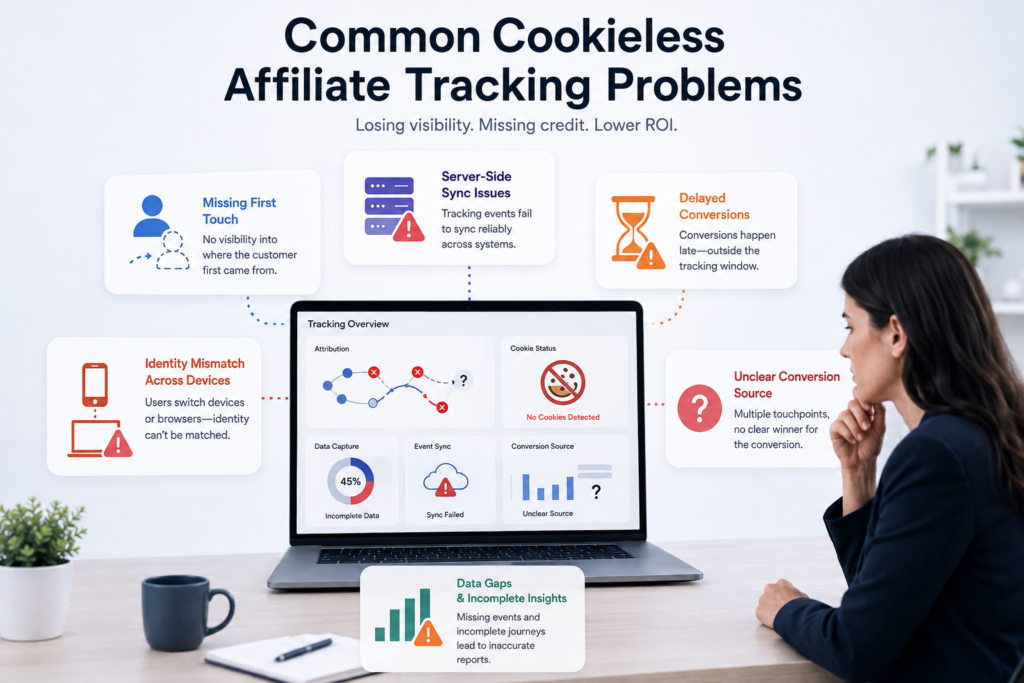
Lost parameters caused by redirects and link shorteners
Redirect chains often strip essential URL parameters before they reach your landing page. When a user clicks a link, intermediate services may drop the affiliate ID or click ID, leaving you with no way to attribute the visit. You should always test your final destination URLs to ensure your cookieless affiliate tracking parameters remain intact.
Duplicate conversions from repeated browser or server events
Duplicate events occur when a user refreshes a confirmation page or when a server sends multiple postbacks for a single transaction. This inflates your conversion numbers and creates discrepancies in your reporting. Implementing unique transaction IDs is the best way to ensure that your system ignores redundant data packets.
Attribution gaps caused by checkout domains and payment providers
Many businesses use third-party checkout domains or external payment gateways that break the tracking session. If your tracking technology cannot pass identifiers across these domain handoffs, the conversion will appear as direct traffic. You must configure cross-domain tracking or use server-side handoffs to maintain the connection between the initial click and the final purchase.
Mismatch between affiliate network and analytics reports
It is common to see differences between your internal analytics and your affiliate network dashboard. These platforms often use different attribution windows, time zones, and filtering rules for invalid traffic. You should focus on identifying trends rather than expecting a perfect one-to-one match between every data source.
Unattributed conversions caused by blocked scripts or missing consent
Privacy-focused browsers and ad-blockers can prevent your tracking scripts from firing entirely. If a user denies consent, your system may fail to capture the necessary attribution signals. To minimize these gaps, consider the following strategies:
- Validate event payloads to ensure all required fields are present.
- Use server-side postbacks to bypass client-side script blocking.
- Confirm that your domain handoffs are configured correctly for secure data transmission.
- Audit your consent management platform to ensure it is not overly aggressive in blocking essential tracking.
How to Test and Validate Your Tracking Setup
A robust validation process is the backbone of any successful cookieless affiliate tracking implementation. You must treat your tracking infrastructure like any other critical software component by establishing a repeatable test plan. This plan should cover the entire journey from the initial affiliate click to the final conversion event.
Testing the complete path from affiliate click to conversion
Start your testing by simulating a real user journey. Click on an affiliate link, navigate through your landing pages, and complete a test transaction. You need to ensure that the attribution signal persists across every page load and session transition.
Verify that your system captures the necessary parameters before the user reaches the checkout page. If the data drops off during navigation, your attribution will fail. Consistent data capture is essential for maintaining accurate performance metrics.
Verifying click IDs, transaction IDs, and conversion values
Once a test conversion occurs, inspect the data payload sent to your server. Confirm that the click ID and transaction ID match the values generated at the start of the session. Any mismatch here will lead to broken attribution and lost commission data.
Check that the currency values and commission amounts are calculated correctly. Even a small error in decimal placement can cause significant discrepancies in your financial reporting. Precision in data transmission ensures that your partners receive accurate payouts.
Checking postback responses, retries, and duplicate protection
Your server-side tracking must handle communication errors gracefully. Test your system by simulating a failed postback to see if your retry logic triggers as expected. This prevents data loss during temporary network outages.
Implement strict duplicate protection to avoid counting the same transaction multiple times. Your system should check for existing transaction IDs before recording a new conversion. This step is vital for maintaining the integrity of your cookieless affiliate tracking reports.
Comparing network, server, and analytics reporting
Reconciliation is the final step in validating your data. Compare the conversion counts in your affiliate network dashboard against your internal server logs and analytics platform. While minor variations are normal, large gaps indicate a fundamental tracking failure.
Use the following table to track your validation metrics across different systems:
| Metric Type | Network Dashboard | Internal Server Logs | Analytics Platform |
|---|---|---|---|
| Click Volume | Verified | Verified | Verified |
| Conversion Count | Matched | Matched | Matched |
| Revenue Data | Accurate | Accurate | Accurate |
| Status Codes | 200 OK | 200 OK | 200 OK |
Monitoring tracking health after website and checkout changes
Your tracking setup is not a “set it and forget it” system. Every time you update your website, change your checkout flow, or modify your privacy settings, you must re-test your tracking. Small code changes can inadvertently break the scripts that capture attribution data.
Set up automated alerts to notify your team if conversion data stops flowing or if error rates spike. Proactive monitoring allows you to fix issues before they impact your cookieless affiliate tracking performance. Maintaining a healthy system requires constant vigilance and regular audits.
How to Measure Cookieless Affiliate Performance
Accurate cookieless affiliate tracking performance measurement is the backbone of a successful affiliate strategy. As you transition to modern tracking technology, your focus must shift from individual user tracking to aggregate data analysis. This approach ensures you maintain visibility into your program’s health while respecting user privacy.

Tracking conversion rate, revenue, and earnings per click
To evaluate your success, you should monitor core metrics like conversion rate, total revenue, and earnings per click (EPC). These indicators provide a clear picture of how effectively your partners drive high-value traffic. By analyzing these figures, you can identify which affiliates consistently deliver the best return on investment.
Separating attributed, unattributed, and rejected conversions
Avoid the mistake of looking at a single blended total for your conversions. You must separate attributed, unattributed, pending, refunded, and rejected outcomes to gain actionable insights. This granular view helps you understand the true impact of your tracking technology and highlights areas where your funnel might be leaking value.
| Metric Category | Definition | Business Impact |
|---|---|---|
| Attributed | Verified partner sales | Direct ROI calculation |
| Unattributed | Direct or organic traffic | Baseline performance check |
| Rejected | Canceled or fraudulent | Quality control monitoring |
Using cohort and partner-level reporting to guide decisions
Cohort analysis allows you to group customers based on their acquisition date or the partner who referred them. This method reveals long-term value trends that simple daily reports often miss. By focusing on partner-level performance, you can reward top-tier affiliates and provide constructive feedback to those who need improvement.
Identifying attribution trends without relying on perfect user-level data
When complete user-level attribution is unavailable, you should focus on identifying broader trends. This is especially important when using cookieless affiliate tracking. Monitor changes in conversion volume relative to traffic spikes to infer the effectiveness of your campaigns. Consistent reporting windows and defined attribution models will help you spot patterns even when individual data points are incomplete.
Improving affiliate relationships with transparent reporting
Transparency is essential for building trust with your partners. Clear reporting also makes cookieless affiliate tracking easier for partners to understand. Share clear definitions of how you measure success and explain your tracking technology limitations openly. When affiliates understand your reporting process, they are more likely to align their promotional efforts with your business goals, leading to a stronger, more profitable partnership.
Upgrade Your Affiliate Tracking
Ready to make your affiliate reporting more accurate? Explore reliable tracking technology, reduce attribution gaps, and build a measurement system ready for the future.
Conclusion
Building a resilient measurement strategy is the key to long-term success in the digital landscape. You can achieve accurate results by combining first-party signals, server-side conversion events, and secure identifiers. Integrating promo codes and account data provides additional layers of reliability for your cookieless tracking affiliate efforts.
Reliable cookieless affiliate tracking depends on clearly defined events and durable data handoffs. You must prioritize duplicate prevention and strict privacy safeguards to maintain integrity. Start with the simplest reliable approach to ensure your foundation remains stable as you scale.
Improve your attribution quality through consistent validation and regular reconciliation of your data. Transparent reporting strengthens your relationships with partners and provides a clearer view of your return on investment. Adopting a proactive mindset toward your cookieless tracking affiliate setup ensures you stay ahead of industry changes. Your commitment to precise, privacy-first measurement will drive better decisions and sustainable growth for your brand.
FAQs
What exactly is cookieless affiliate tracking and why is it necessary?
Cookieless affiliate tracking is a privacy-conscious method of measuring conversions without relying on third-party cookies, which are increasingly blocked by browsers like Apple Safari and Google Chrome. By using this tracking technology, you can attribute sales through first-party identifiers, URL parameters, and server-side signals, ensuring your affiliate revenue remains stable even as traditional tracking methods vanish.
How does the tracking technology bridge the gap between a click and a conversion?
The process begins when an affiliate link transmits a unique Click ID to your website. Instead of storing this in a third-party cookie, your site captures the ID and stores it in your own first-party environment. When a customer completes a purchase, your server sends the transaction data directly to the affiliate platform, such as Impact or CJ Affiliate, effectively connecting the original click to the final sale without browser interference.
Why is server-to-server postback tracking considered more reliable?
Server-to-server (S2S) tracking is more dependable because the data exchange happens directly between your backend and the affiliate network. Because it does not rely on client-side scripts that can be hindered by ad blockers or Apple’s Intelligent Tracking Prevention (ITP), it provides a “hardened” attribution path. This makes you a more attractive cookieless tracking affiliate partner because your data is less susceptible to browser-based signal loss.
Can I still use promo codes for attribution in a cookieless environment?
Absolutely. Promo codes are one of the most effective cookieless affiliate tracking tools available. By assigning a unique code to a specific partner, you can attribute the conversion regardless of whether a cookie was set or if the customer switched devices. This is particularly useful for influencers on YouTube or Instagram who drive traffic that doesn’t always originate from a direct click.
What are the privacy and compliance implications of moving to cookieless tracking?
While moving away from third-party cookies improves privacy, you must still comply with United States regulations like the California Consumer Privacy Act (CCPA). You are responsible for documenting consent and providing clear opt-out choices for your users. It is also critical to avoid device fingerprinting, as this practice can create significant compliance risks by collecting persistent device characteristics without transparent user control.
How do payment providers like PayPal or Stripe affect my tracking accuracy?
Transitioning a customer to an external domain for payment often causes “attribution gaps” where the original session data is lost. To maintain your cookieless tracking affiliate integrity, you must ensure that your system can pass the Click ID to the payment processor and receive it back via a “return URL” or use server-side notifications to trigger the conversion event once the payment is confirmed.
How should I test my new cookieless tracking setup to ensure it works?
You should establish a repeatable validation plan that follows the full customer journey. Start by clicking a live affiliate link, verifying that the Click ID is captured on your landing page, and then completing a test transaction. Check that the postback successfully reaches your affiliate network with the correct transaction ID and commission value, and verify that your system prevents duplicate commissions if the page is refreshed.
Why do my affiliate network reports sometimes differ from my internal analytics?
Discrepancies often arise because different platforms use different attribution windows, time zones, or deduplication rules. These differences can also affect cookieless affiliate tracking reports. While your internal Google Analytics might use a “last non-direct click” model, your affiliate tracking technology might be set to “first-click” or a 30-day window. Focus on long-term trends and cohort analysis rather than expecting a perfect 1:1 match between every individual data point.
1 thought on “Cookieless Affiliate Tracking: How to Track Affiliate Conversions Without Third-Party Cookies”