
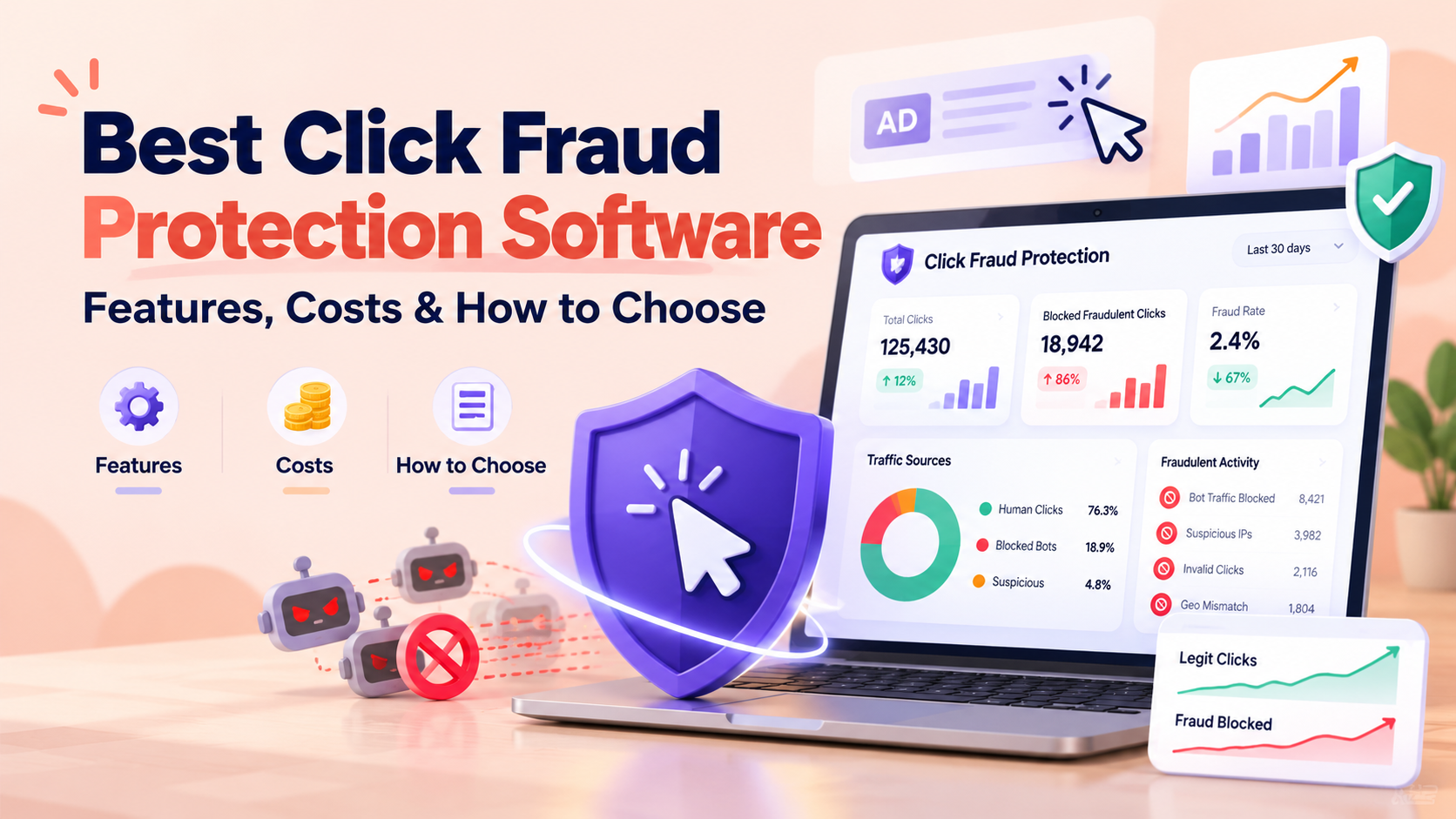
Are you tired of watching your marketing budget vanish into thin air due to invalid traffic? Every day, businesses lose significant revenue to automated bots and malicious actors targeting their digital ads.
This guide serves as a practical resource for advertisers evaluating the best click fraud protection software for ad campaigns in 2026. We will examine six leading providers to help you navigate complex pricing models and technical requirements.
You will learn how to compare the best click fraud protection software based on detection accuracy, platform integrations, and overall campaign suitability. By the end of this analysis, you will have the clarity needed to select the best click fraud protection software 2026 that aligns with your specific operational goals and financial constraints.
Key Takeaways
- Identify how automated traffic drains your advertising budget.
- Compare top-tier tools based on real-world performance and cost.
- Understand the importance of seamless platform integration for your campaigns.
- Learn to evaluate detection accuracy to ensure maximum ROI.
- Select the right solution tailored to your unique business requirements.
Protect Your Ad Budget Today
Stop wasting valuable advertising dollars on fraudulent clicks and automated traffic. Discover reliable click fraud protection designed to safeguard campaigns, improve traffic quality, and maximize ROI.
What Click Fraud Protection Software Does for Your Ad Campaigns
Modern digital marketing success depends on your ability to distinguish between genuine customers and harmful automated traffic. When your ads appear online, they are exposed to a variety of interactions that do not lead to sales. Utilizing the best click fraud protection software for ad campaigns ensures that your marketing dollars reach real people who are interested in your products.
How click fraud drains PPC budgets and distorts campaign data
Every time a malicious actor clicks your ad, you pay for a visit that has zero chance of converting. The best click fraud protection software can help reduce this wasted spend, preventing your daily budget from being depleted before high-intent users even see your ads. Furthermore, this activity skews your performance metrics, making it difficult to optimize your bidding strategies effectively.
The difference between invalid clicks, accidental clicks, bots, and deliberate fraud
Not all non-converting traffic is malicious, but all of it impacts your bottom line. Understanding these categories helps you evaluate the best click fraud protection software for your approach to traffic management.
| Traffic Type | Intent | Impact on Budget |
|---|---|---|
| Accidental Clicks | Unintentional | Low to Moderate |
| Automated Bots | Systematic | High |
| Deliberate Fraud | Malicious | Very High |
How ppc fraud protection identifies, blocks, and reports suspicious traffic
The best click fraud protection software works by analyzing thousands of data points in real time to provide advanced ppc. They monitor IP addresses, device fingerprints, and user behavior patterns to detect anomalies that signal non-human activity. Once identified, the software automatically blocks these sources from seeing your ads, ensuring your budget is reserved for legitimate prospects.
When you need dedicated click fraud software instead of native ad-platform controls
While major advertising platforms offer basic filters, they often lack the granular control required to stop sophisticated threats. Dedicated click fraud software provides a deeper layer of security that native tools simply cannot match. If you notice high bounce rates or suspicious spikes in traffic, it is time to implement the best click fraud protection software to protect your investment.
By integrating robust click fraud software, you gain access to detailed reports that serve as evidence for refund requests. This proactive stance on ppc fraud protection allows you to maintain a healthy return on ad spend while keeping your data clean and actionable.
How to Evaluate the Best Click Fraud Protection Software
Selecting the right click fraud software requires a deep understanding of your specific advertising ecosystem. Because every business faces unique threats, you need a solution that aligns with your technical requirements and budget. A robust evaluation framework ensures you invest in a tool that actually improves your bottom line.
Detection accuracy across Google Ads, Microsoft Advertising, and paid social
The best click fraud protection software must offer cross-channel visibility. Effective ppc fraud protection should monitor traffic across Google Ads, Microsoft Advertising, and major social media networks simultaneously. If the best click fraud protection software only covers one search engine, you leave your social campaigns vulnerable to sophisticated bot attacks.
Real-time monitoring, automated blocking, and delayed traffic analysis
Speed is essential when dealing with malicious actors. When evaluating the best click fraud protection software, look for real-time monitoring to stop fraudulent clicks before they exhaust your daily budget. While automated blocking is a primary feature, some advanced threats require delayed traffic analysis to identify patterns that only emerge over several hours.
IP exclusion, device fingerprinting, VPN detection, and bot identification
Advanced detection relies on multiple layers of data. The best click fraud protection software relies on multiple layers of data for advanced detection. A high-quality tool uses dev
ice fingerprinting to track users even when they rotate IP addresses or use VPNs to mask their location. By combining these methods, the software can distinguish between a genuine user and a programmed bot.
Campaign integrations, conversion tracking, and analytics compatibility
Seamless integration with your existing tech stack is non-negotiable. Your best click fraud protection software should sync directly with your CRM and analytics platforms to provide a unified view of your data. This compatibility allows you to correlate blocked traffic with actual conversion drops, proving the return on investment of your security measures.
Reporting depth, evidence quality, and support for refund or dispute requests
When you use the best click fraud protection software, you need actionable data to reclaim your funds when fraud is identified. The best click fraud protection software provides detailed evidence logs that you can submit to ad platforms for refund requests. High-quality reporting should clearly categorize the type of fraud, such as click farms or automated scrapers, to help you refine your targeting.
Privacy compliance, data retention, and protection against false positives
Aggressive blocking can sometimes harm your campaign performance if it targets legitimate customers. When choosing the best click fraud protection software, you must prioritize privacy compliance and ensure the software adheres to regulations like GDPR or CCPA. A balanced approach to ppc fraud protection minimizes false positives, ensuring that your ads continue to reach high-intent prospects without unnecessary restrictions.
Best Click Fraud Protection Software at a Glance
The market for ad security is crowded, but a quick comparison can help you identify the best click fraud protection software for your campaigns in 2026. Selecting the right tool requires a clear understanding of how different platforms handle traffic analysis and automated blocking. By evaluating these solutions side-by-side, you can protect your marketing budget from wasted spend.
Comparison criteria for features, pricing, integrations, and campaign size
When evaluating the best click fraud protection software, you must look beyond basic blocking capabilities. Key criteria include the depth of device fingerprinting, the speed of real-time IP exclusion, and the quality of reporting dashboards. You should also verify that the software integrates seamlessly with your existing ad platforms like Google Ads or Meta.
Which tools suit small businesses, agencies, and enterprise advertisers
Different providers of the best click fraud protection software cater to specific market segments based on their infrastructure and support models. Small businesses often prioritize ease of use and flat-rate pricing, while agencies require multi-account management and white-label reporting. Enterprise advertisers typically demand advanced bot detection, custom API access, and dedicated account management to handle massive traffic volumes.
How to interpret pricing when vendors charge by ad spend, clicks, or traffic volume
Pricing models significantly impact the long-term value of the best click fraud protection software you choose. Some providers charge based on your total monthly ad spend, which scales automatically with your growth. Others use a per-click or per-visitor model, which can be more cost-effective if you have high traffic but low conversion rates. Always calculate your potential savings against these recurring costs to ensure a positive return on investment.
Quick comparison of best click fraud software
The following table provides a high-level overview of the best click fraud protection software options currently leading the industry. Each platform offers unique strengths depending on your specific campaign needs.
| Provider | Best For | Pricing Model |
|---|---|---|
| LinksTrackly | Advertisers & performance marketers | Subscription / Click Volume |
| ClickCease | Small to Mid-sized | Ad Spend |
| CHEQ Essentials | Enterprise | Traffic Volume |
| Lunio | Agencies | Ad Spend |
| PPC Protect | Mid-sized | Ad Spend |
| Fraud Blocker | Small Business | Clicks |
| TrafficGuard | Enterprise | Custom/Volume |
Detailed Comparison of Leading Click Fraud Software
Not all security solutions are created equal, and choosing the best click fraud protection software depends on your unique business needs. By evaluating the top-tier providers in the industry, you can better secure your campaigns against malicious activity and wasted spend.
LinksTrackly
Overview and best use cases
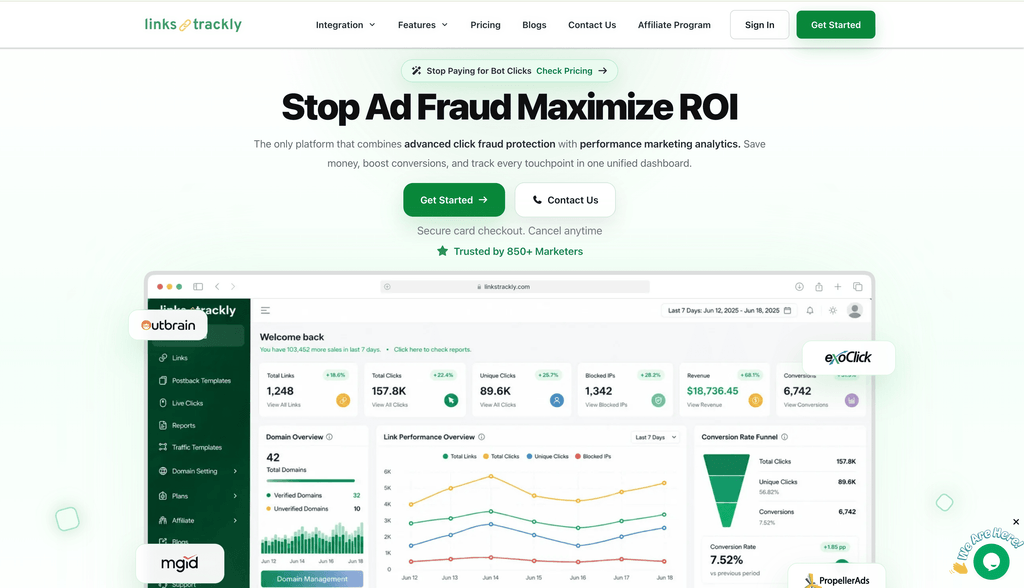
LinksTrackly combines click fraud protection with the features advertisers may expect from the best click fraud protection software, including performance tracking, and attribution in a unified platform. It is designed for advertisers and performance marketers who want to protect ad spend while gaining visibility into campaign and customer-journey performance.
Key features, integrations, and monitoring controls
The platform provides the real-time fraud blocking and monitoring capabilities advertisers may look for in the best click fraud protection software, including click-threshold limitations, VPN traffic exclusion, visitor analytics, and automatic IP exclusion.
It also offers advanced rules and targeting, custom conversion events, detailed reporting, and real-time analytics. LinksTrackly states that it integrates with platforms including Google Ads, Facebook, and LinkedIn.
Pros for advertisers seeking fraud protection and performance analytics
A key advantage is the combination of anti-fraud protection and campaign analytics in one dashboard. Advertisers can monitor incoming traffic, identify suspicious clicks, track conversions, and analyze campaign performance without relying on separate tools for fraud detection and attribution.
Cons, limitations, and potential considerations
Because LinksTrackly combines several marketing functions, advertisers should evaluate whether its feature set matches their specific campaign requirements. Before committing, it is also worth testing integrations, reporting capabilities, detection controls, and pricing against your current advertising volume and workflow.
Recommended advertiser profile and campaign size
LinksTrackly is positioned for advertisers, performance marketers, agencies, and businesses managing multiple paid traffic sources. It may be particularly relevant for teams looking for an all-in-one platform that combines click fraud protection with tracking, attribution, and campaign optimization.
ClickCease
Overview and best use cases
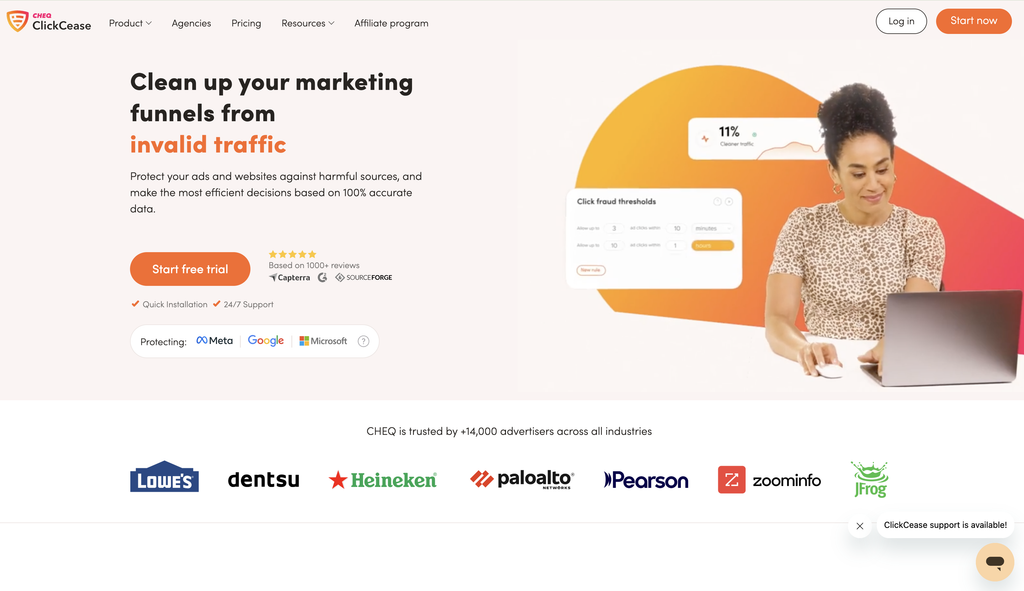
ClickCease is a widely recognized name in the industry, primarily serving small to medium-sized businesses. It is designed to provide immediate protection for Google Ads and Microsoft Advertising campaigns.
Key features, integrations, and monitoring controls
The platform offers automated IP blocking and real-time click monitoring. It integrates seamlessly with major search engines to ensure your ads are only seen by genuine users.
Pros for Google Ads and Microsoft Advertising campaigns
Users benefit from a user-friendly dashboard and quick setup. It is highly effective at stopping bot traffic that targets search-based ads.
Cons, limitations, and potential false-positive concerns
Some users report that the aggressive blocking settings can occasionally lead to false positives. This requires periodic manual review of your exclusion lists.
Recommended advertiser profile and campaign size
This tool is ideal for small businesses or solo entrepreneurs managing limited budgets on search platforms.
CHEQ Essentials
Overview and best use cases
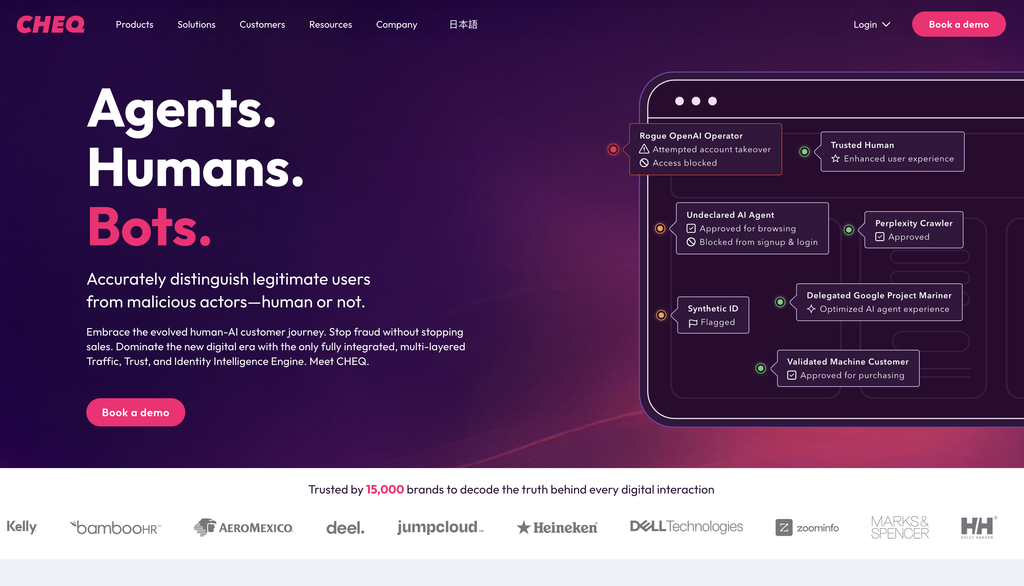
CHEQ Essentials focuses on enterprise-grade security for a broader range of digital channels. It is built for companies that need robust protection across multiple platforms.
Key features for invalid traffic detection and paid media protection
The software utilizes advanced cybersecurity technology to identify sophisticated bot networks. It provides comprehensive coverage for paid search and social media.
Pros for advertisers that need broader multi-channel coverage
It excels at protecting complex media programs that span across various social networks and search engines. The multi-channel visibility is a major advantage for larger teams.
Cons, implementation considerations, and pricing complexity
The implementation process can be more involved than simpler tools. Pricing structures may also be complex for smaller organizations.
Recommended advertiser profile and campaign size
This is best suited for mid-market to enterprise-level advertisers with significant monthly ad spend.
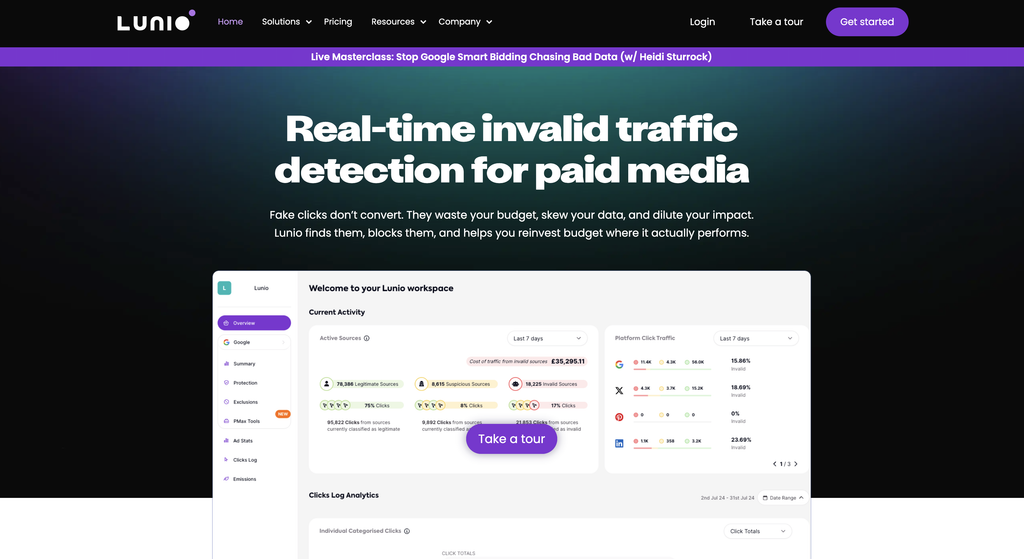
Lunio
Overview and best use cases
Lunio is a powerful analytics-driven platform that emphasizes audience quality. It is particularly popular among agencies that manage multiple client accounts.
Key features for click analysis, audience quality, and campaign optimization
The software provides deep insights into traffic sources and user behavior. It helps you optimize your campaigns by filtering out low-quality clicks before they impact your conversion rates.
Pros for agencies managing multiple client accounts
Agencies appreciate the centralized reporting and the ability to manage multiple accounts from a single dashboard. It simplifies the process of proving value to clients.
Cons, reporting limitations, and account setup requirements
The initial setup requires careful configuration to ensure all tracking pixels are correctly placed. Some users find the reporting interface has a learning curve.
Recommended advertiser profile and campaign size
Lunio is highly recommended for digital marketing agencies and large brands with complex campaign structures.
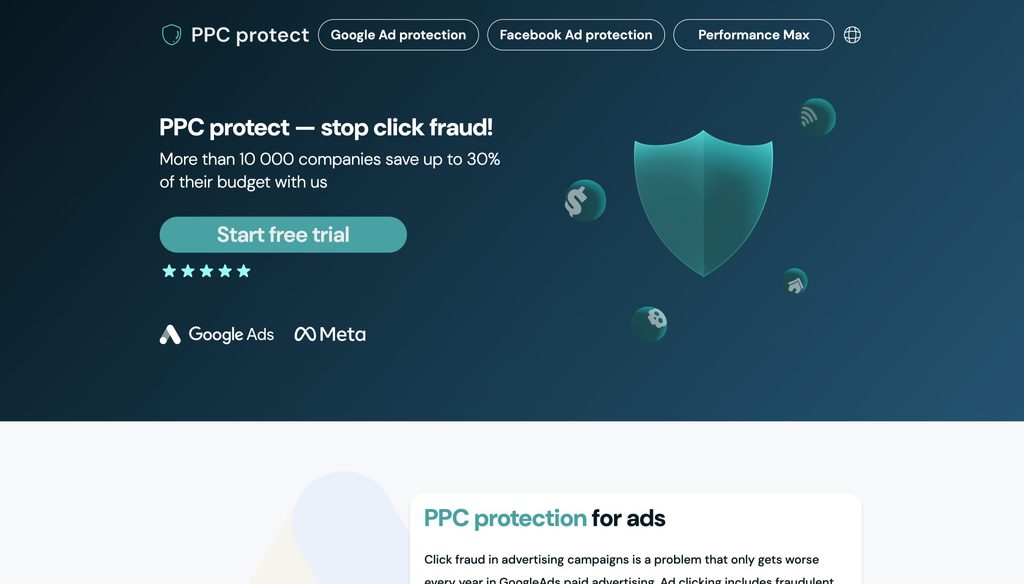
PPC Protect
Overview and best use cases
PPC Protect offers a streamlined approach to automated click blocking. It is a solid choice for advertisers who want a “set it and forget it” solution for their search ads.
Key features for automated click blocking and PPC monitoring
The system monitors your traffic 24/7 and automatically updates your IP exclusion lists. It is specifically optimized for Google Ads and Microsoft Advertising.
Pros for focused Google Ads and Microsoft Advertising protection
The automated nature of the platform saves significant time for busy marketers. It provides clear evidence of blocked threats in an easy-to-read format.
Cons, coverage limitations, and operational considerations
It is primarily focused on search traffic, which may limit its utility for those heavily invested in display or social media ads.
Recommended advertiser profile and campaign size
This tool is perfect for mid-sized businesses that want reliable protection without excessive manual oversight.
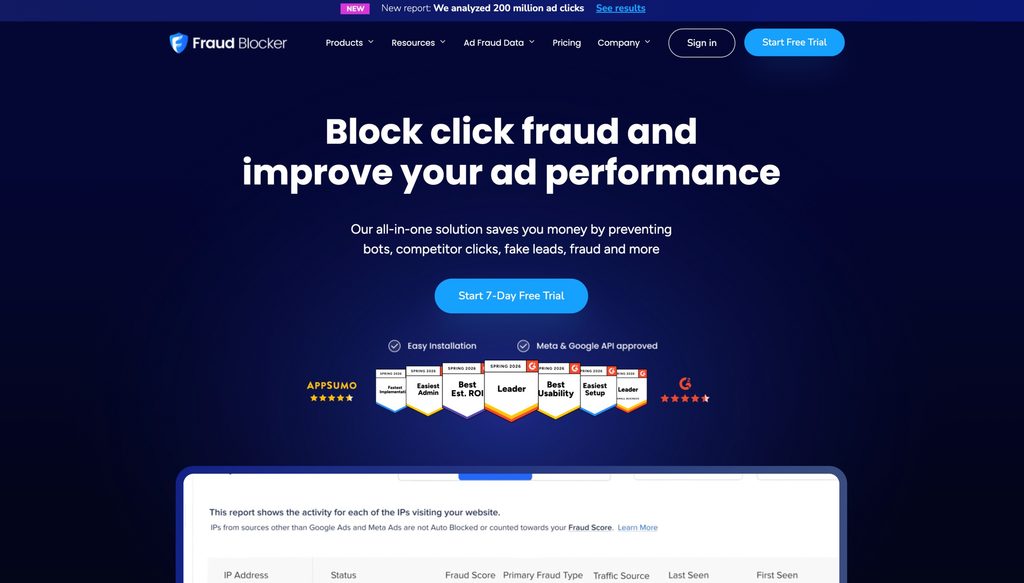
Fraud Blocker
Overview and best use cases
Fraud Blocker is designed for simplicity and ease of use. It is one of the most accessible options for those new to using click fraud software.
Key features for identifying suspicious clicks and excluding bad traffic
The platform provides a straightforward dashboard that highlights suspicious activity. It allows for quick exclusion of malicious IPs with just a few clicks.
Pros for small businesses seeking a simpler deployment
The deployment process is fast and requires minimal technical expertise. It is an excellent entry-level solution for protecting your ad budget.
Cons, scalability questions, and reporting trade-offs
As your campaigns grow, you may find the reporting features somewhat limited compared to enterprise-grade alternatives. It may not offer the same depth of data for massive ad programs.
Recommended advertiser profile and campaign size
This is an ideal choice for small businesses and startups with limited technical resources.
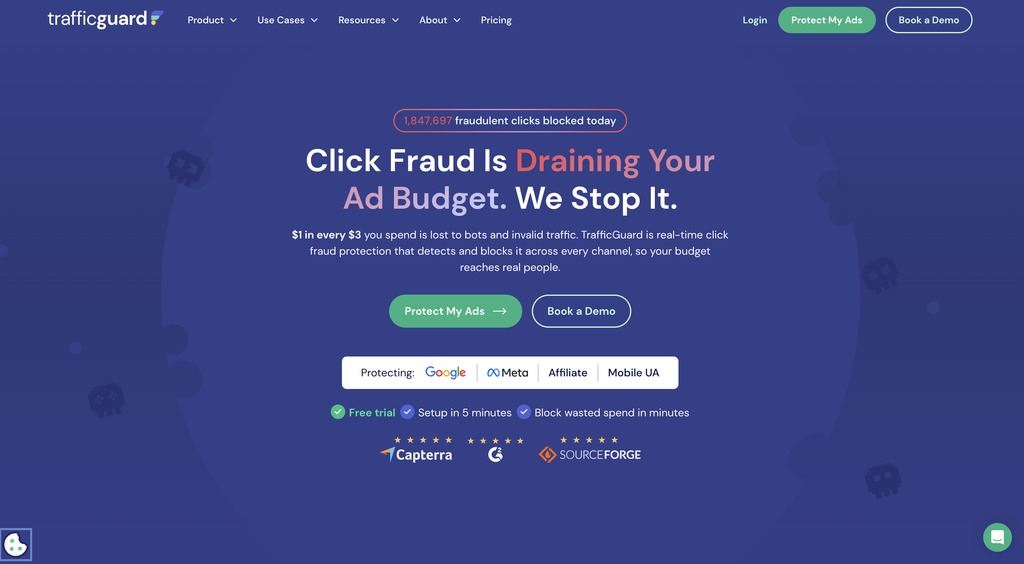
TrafficGuard
Overview and best use cases
TrafficGuard provides comprehensive, cross-channel invalid traffic prevention. It is built to handle the demands of large-scale, complex media programs.
Key features for cross-channel invalid traffic prevention
The platform offers real-time mitigation across search, social, and programmatic display. It uses advanced machine learning to detect evolving fraud patterns.
Pros for enterprise advertisers and complex media programs
The depth of protection is unmatched, making it a top contender for the best click fraud software for large organizations. It provides granular control over your traffic quality.
Cons, onboarding effort, and likely budget requirements
The onboarding process is intensive and requires a dedicated team to manage effectively. It also comes with a higher price point that reflects its enterprise capabilities.
Recommended advertiser profile and campaign size
TrafficGuard is best for large enterprises and global brands with substantial monthly advertising budgets.
Click Fraud Protection Software Costs and Pricing Models
Finding the best click fraud protection software 2026 starts with a transparent look at how these services charge for their expertise. Because every business has a unique advertising footprint, vendors utilize various models to ensure their pricing scales with your actual usage.
Common subscription models based on ad spend, clicks, impressions, or traffic volume
Most providers align their fees with the scale of your digital advertising. You will typically encounter one of the following billing structures:
- Ad Spend Percentage: Fees are calculated as a small percentage of your total monthly advertising budget.
- Click-Based Pricing: You pay based on the number of clicks processed or protected by the system.
- Traffic Volume: Costs are tied to the total number of visitors or impressions hitting your landing pages.
Typical cost differences between small-business, agency, and enterprise plans
Pricing tiers are designed to accommodate different organizational needs. Small businesses often benefit from flat-rate monthly subscriptions, while larger entities require custom quotes.
| Plan Type | Primary Focus | Pricing Structure |
|---|---|---|
| Small Business | Basic protection | Fixed monthly fee |
| Agency | Multi-client management | Tiered volume discounts |
| Enterprise | High-volume security | Customized annual contracts |
Additional expenses for setup, managed services, custom integrations, and premium support
Beyond the base subscription, you should account for potential hidden costs. Some vendors charge one-time setup fees for complex API integrations or custom dashboard configurations.
Premium support packages are often available for an extra fee. These services provide dedicated account managers who help you interpret complex traffic data and refine your exclusion rules.
How to calculate break-even savings from blocked fraudulent clicks
To justify the investment, you must measure the value of the traffic you recover. Calculate your break-even point by comparing the monthly software cost against the average cost-per-click (CPC) of the fraudulent traffic you have successfully blocked.
“The true value of security software is not just in the clicks it blocks, but in the quality of the leads it preserves for your sales team.”
If your software blocks $1,000 worth of fraudulent clicks per month and costs $200, you have achieved a clear 5x return on your investment. This calculation helps you determine if the best click fraud protection software is truly paying for itself.
Questions to ask before accepting a free trial or annual contract
Before committing to a long-term agreement, ensure you have full clarity on the terms. Ask the provider how they handle data retention and whether they offer prorated refunds if your ad spend drops significantly.
Always verify if the trial period includes full access to all features. Understanding these details early will prevent unexpected costs and ensure your chosen solution remains a cost-effective asset for your marketing strategy.
How to Choose the Right Tool for Your Campaigns
Finding the best click fraud protection software for ad campaigns involves balancing your technical requirements with your overall marketing goals. Because every business faces different levels of risk, a one-size-fits-all approach rarely delivers the results you need to protect your bottom line.
Find the Right Click Fraud Protection
Compare your campaign needs, traffic risks, and budget against powerful protection features. Choose a solution that helps detect suspicious activity and preserve your advertising investment.
Choose based on advertising platforms, monthly spend, and campaign complexity
Start by auditing where your ads run. Ensure the software supports your specific mix of Google Ads, Microsoft Advertising, or social media platforms.
Your monthly ad spend should dictate the level of sophistication you require. High-volume accounts often need real-time automated blocking, while smaller budgets might benefit from periodic traffic analysis to keep costs manageable.
Select features according to your fraud risk and conversion objectives
Assess your industry’s vulnerability to bot traffic and competitor clicking. If you operate in a high-CPC niche, prioritize tools with advanced device fingerprinting and VPN detection capabilities.
Align these features with your primary conversion goals. If your success depends on lead quality, look for software that integrates directly with your CRM to verify that blocked clicks are truly low-value.
Match deployment requirements to your technical resources and workflow
Consider how much time your team can dedicate to managing a new security layer. Some platforms offer “set it and forget it” automation, while others require manual rule configuration.
Evaluate whether the tool integrates seamlessly with your existing analytics stack. A smooth workflow ensures that your team spends less time troubleshooting and more time optimizing high-performing campaigns.
Use trial data to validate detection accuracy and measurable savings
Most vendors offer a trial period, which is the perfect time to test their claims. Use this window to monitor how many suspicious clicks the software identifies compared to your historical baseline.
Calculate the potential return on investment of the best click fraud protection software by comparing its cost against the savings from recovered ad spend. This data-driven approach removes guesswork from your final decision.
Confirm how the provider handles false positives, appeals, and blocked traffic
Even the best click fraud protection software for ad campaigns can occasionally flag legitimate users. Ask the provider how they handle these false positives to ensure you do not lose genuine customers.
Review their process for submitting appeals if a high-value IP is accidentally blocked. A transparent provider will offer clear reporting and a straightforward way to whitelist important traffic sources.
| Criteria | Low Complexity | High Complexity |
|---|---|---|
| Monthly Spend | Under $5,000 | Over $50,000 |
| Automation Level | Semi-Automated | Fully Automated |
| Support Needs | Email/Knowledge Base | Dedicated Account Manager |
| Primary Goal | Cost Reduction | Conversion Optimization |
Implementing and Measuring Your Click Fraud Protection System
Once you have selected your tool, the real work of securing your advertising budget begins with proper implementation. A strategic setup ensures that your click fraud software functions as a silent guardian for your digital assets. By following a methodical process, you can protect your campaigns without disrupting the flow of genuine customer traffic.
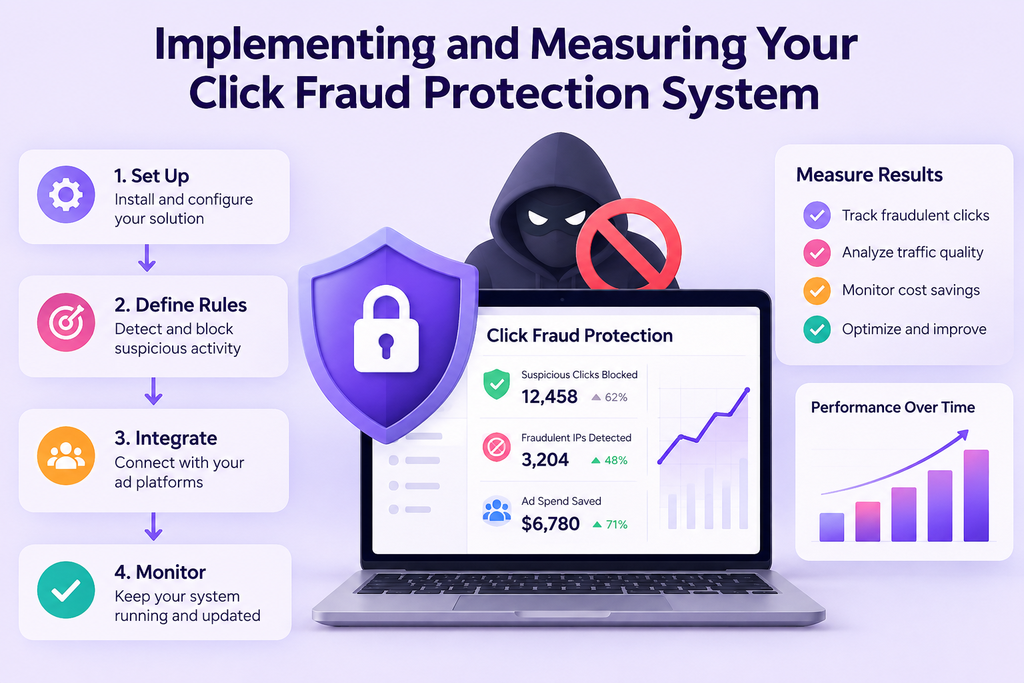
Connect your advertising accounts, analytics tools, and conversion tracking
The first step involves linking your ad platforms, such as Google Ads or Microsoft Advertising, directly to your security dashboard. This integration allows the software to pull real-time data and push exclusion lists automatically. You must also ensure your conversion tracking pixels are correctly mapped to verify which clicks lead to actual business value.
Set exclusion rules without blocking legitimate prospects
Configuring your exclusion rules requires a delicate balance. You want to block malicious bots and repeat offenders while keeping the door open for high-intent users. Start with conservative settings to avoid false positives that could inadvertently hurt your reach. Over time, you can tighten these rules as you gain confidence in the system’s detection accuracy.
“Effective ppc fraud protection is not just about blocking traffic; it is about understanding the behavior of your audience and ensuring that every dollar spent contributes to your bottom line.”
Establish baseline metrics for click-through rate, conversion rate, and cost per acquisition
Before enabling full automation, you need a clear picture of your current performance. Document your average click-through rate (CTR), conversion rate, and cost per acquisition (CPA) over the last 30 days. These baseline metrics serve as your benchmark for measuring the success of your new security measures.
Review blocked traffic reports and adjust campaign targeting regularly
Your dashboard will provide detailed reports on the traffic being intercepted. Regularly reviewing these logs helps you identify patterns, such as specific geographic regions or device types that generate high volumes of invalid clicks. Use this intelligence to refine your campaign targeting and exclude low-quality segments at the source.
Measure recovered budget, lead quality, and incremental return on ad spend
The ultimate goal of ppc fraud protection is to improve your bottom line. By tracking the budget saved from blocked clicks, you can reallocate those funds toward high-performing keywords. Monitor your lead quality and incremental return on ad spend (ROAS) to confirm that your investment in security is paying off.
| Action Item | Frequency | Primary Goal |
|---|---|---|
| Account Sync | One-time | Data Integration |
| Rule Calibration | Monthly | Minimize False Positives |
| Performance Audit | Quarterly | Verify ROI Gains |
Common Mistakes When Buying Click Fraud Software
Investing in protection software requires more than just picking the cheapest option on the market. Many advertisers rush into a purchase without fully understanding how different platforms identify malicious traffic. Finding the best click fraud protection software for your specific needs demands a strategic approach rather than a quick transaction.
Choosing the cheapest tool without comparing detection methods
Price is often the primary driver for many businesses, but low-cost tools frequently lack advanced detection capabilities. You must compare how each provider identifies threats, such as device fingerprinting or behavioral analysis. Relying on basic IP blacklisting alone may leave your campaigns vulnerable to sophisticated botnets.
Assuming every suspicious click is confirmed advertising fraud
It is a mistake to label every unusual spike in traffic as malicious activity. Some traffic might simply be high-intent users or accidental clicks that do not represent a coordinated attack. False positives can lead to blocking legitimate customers, which ultimately hurts your conversion rates.
“The goal of any security implementation is to protect your budget without stifling the growth of your legitimate customer base.”
Ignoring privacy, consent, and data-processing obligations
When you implement tracking tools, you must ensure they comply with regional data laws like GDPR or CCPA. Failing to manage user consent properly can lead to significant legal risks for your company. Always verify that your chosen vendor maintains strict data retention and privacy standards.
Failing to test integrations before enabling automated blocking
Never turn on automated blocking features without a trial period. You need to monitor how the software interacts with your existing analytics and CRM tools. Testing your setup ensures that the system correctly identifies threats before it starts cutting off potential revenue sources.
Expecting software alone to fix poor targeting or low-converting landing pages
Even the best click fraud software cannot save a campaign that suffers from weak messaging or poor audience targeting. If your landing page fails to convert, you might mistake low performance for fraud. Always optimize your ad creative and landing page experience before blaming your traffic quality entirely on bots.
Take Control of Your Ad Spend
Ready to reduce wasted clicks and protect your campaigns? Put smarter traffic monitoring to work and keep more of your advertising budget focused on genuine prospects.
Conclusion
Protecting your digital marketing budget with the best click fraud protection software requires a strategic approach to traffic quality. Selecting the best click fraud protection software involves balancing detection accuracy with your specific campaign needs. You must weigh platform coverage, reporting depth, and pricing models against your actual fraud exposure.
The best click fraud protection software 2026 standards demand more than basic IP blocking. You should prioritize tools that offer robust device fingerprinting and real-time analysis. Your choice hinges on your technical resources and the complexity of your paid media accounts.
Validate your decision by testing provider claims through trial data. Monitor how these systems handle false positives to ensure you never block legitimate customers. Measuring your recovered budget and improved conversion rates will confirm the value of your investment.
Take control of your ad spend today by auditing your current traffic patterns. Implementing the right defense strategy transforms your campaigns into high-performing assets. Your path to better return on ad spend starts with choosing a reliable partner for your business.
FAQs
Why should I invest in the best click fraud protection software for ad campaigns instead of relying on native platform filters?
While platforms like Google Ads and Microsoft Advertising have basic filters, they often lack the granular detection required to catch sophisticated bots and human-led click farms. Dedicated click fraud software provides an independent layer of verification, offering real-time monitoring, device fingerprinting, and detailed evidence reports that you can use to request refunds for invalid traffic that native systems might overlook.
How does ppc fraud protection identify the difference between a bot and a legitimate customer?
Modern ppc fraud protection tools use advanced behavioral analysis, IP exclusion, and VPN detection to distinguish human intent from automated scripts. By analyzing how a user interacts with your landing page such as mouse movements, scroll depth, and click speed—the software can accurately flag non-human activity while ensuring your legitimate prospects can still complete their conversions.
What is the best click fraud protection software 2026 for small businesses with limited budgets?
For smaller advertisers, Linkstrackly and ClickCease are often cited as the best click fraud software due to their user-friendly interfaces and accessible pricing tiers. These platforms allow you to protect your PPC budget without the high implementation costs associated with enterprise-grade solutions, making them ideal for businesses focused on scaling their search campaigns efficiently.
Can the best click fraud protection software handle multi-channel campaigns on Meta, LinkedIn, and TikTok?
Yes, if your strategy extends beyond search, you should look for a solution like CHEQ Essentials, Linkstrackly or TrafficGuard. These providers are designed for multi-channel coverage, helping you maintain audience quality across paid social and display networks where invalid traffic (IVT) patterns differ significantly from traditional search engine fraud.
Will using click fraud software lead to a high rate of false positives?
High-quality software minimizes false positives by using sophisticated exclusion rules and delayed traffic analysis. When evaluating the best click fraud protection software, you should look for tools that offer customizable sensitivity settings. This ensures that you aren’t accidentally blocking high-value customers who may happen to use a VPN or click on your ads more than once during their research phase.
How do pricing models work for the best click fraud software in 2026?
Most providers charge based on your monthly ad spend, the total volume of clicks, or the number of domains you want to protect. For instance, Linkstrackly, Lunio and PPC Protect often cater to agencies and enterprises with pricing that scales based on campaign complexity, while other tools offer flat-rate monthly subscriptions for smaller accounts. Always calculate your break-even savings by comparing the subscription cost against the value of the fraudulent clicks the software identifies.
Is it difficult to implement ppc fraud protection into my existing marketing stack?
Implementation is generally straightforward. Most best click fraud protection software options require you to add a small tracking script to your website and link your advertising accounts via an API. Once connected, the software automatically communicates with platforms like Google Ads to update your IP exclusion lists in real time, requiring very little ongoing manual effort from your team.
Can I use click fraud software to get a refund from advertising platforms?
While click fraud software cannot guarantee or force a refund, it can provide the reporting and traffic evidence needed to support a formal dispute. Tools like LinksTrackly provide real-time fraud detection, visitor analytics, and automated IP exclusion data that can help advertisers identify suspicious activity and document invalid traffic when submitting a claim to an advertising platform.
How can click fraud protection improve campaign performance beyond blocking fraudulent clicks?
Click fraud protection can do more than prevent wasted ad spend. By identifying suspicious traffic and separating it from legitimate visitors, advertisers can get cleaner campaign data, evaluate traffic quality more accurately, and make better decisions about targeting, budget allocation, and conversion optimization.
Can click fraud protection software work alongside campaign tracking and attribution tools?
Yes. Combining fraud protection with campaign tracking and attribution can give advertisers a more complete view of campaign performance. Platforms such as LinksTrackly combine fraud detection with visitor analytics, conversion tracking, reporting, and attribution, helping marketers connect traffic quality with campaign outcomes and optimize their advertising spend.