
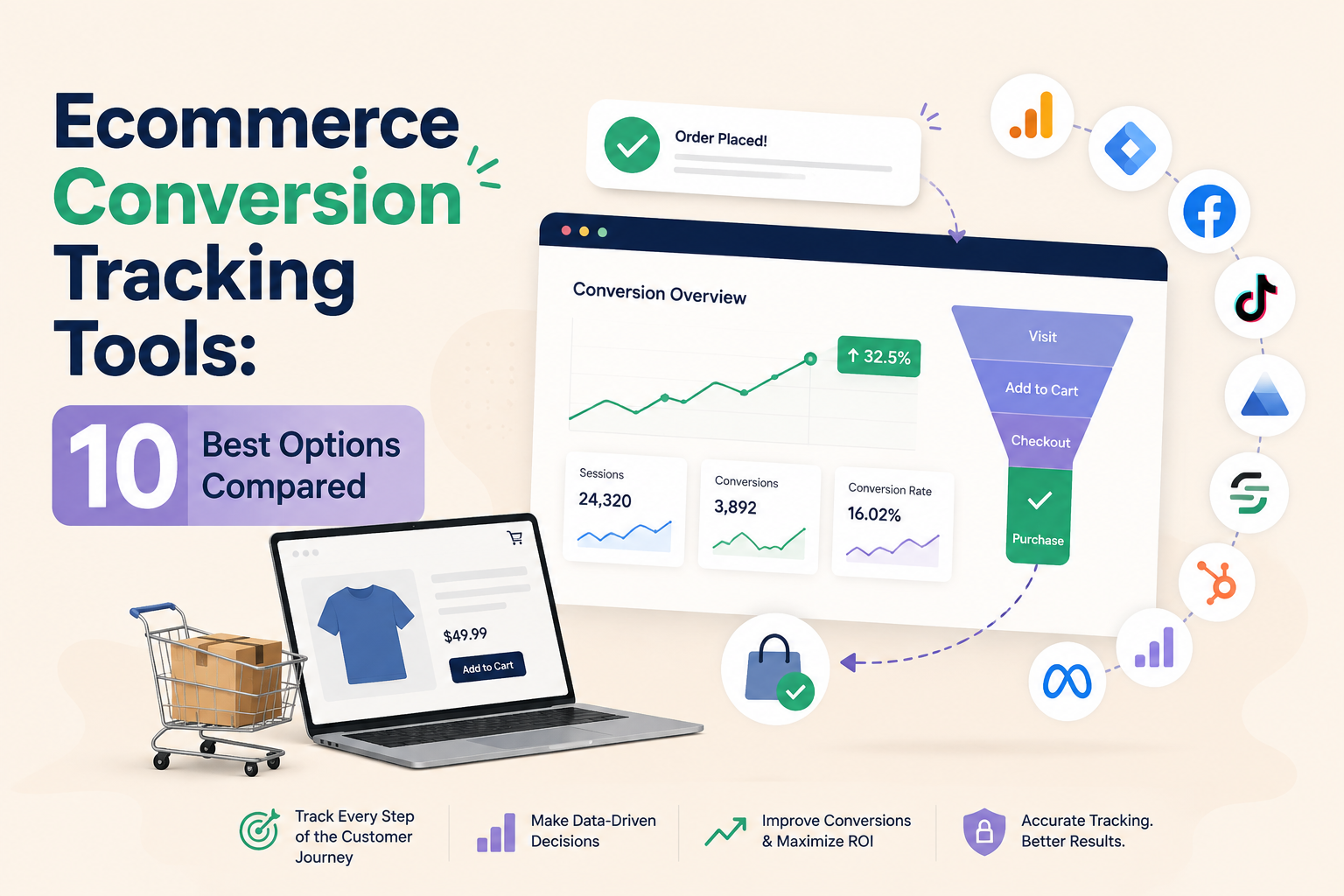
Do you truly know which marketing efforts drive your revenue, or are you simply guessing where your sales originate? Mastering ecommerce conversion tracking is the foundation for understanding how visitors transform into loyal customers. Without precise data, you are essentially flying blind in a competitive digital marketplace.
This guide compares ten powerful conversion tracking tools to help you gain clarity. We examine everything from behavioral platforms and attribution systems to store-native solutions. Your final choice should align with your specific platform, reporting needs, and current growth stage.
By evaluating these options, you will select the right ecommerce conversion tracking setup with total confidence. Let us explore how to turn raw data into actionable business intelligence.
Key Takeaways
- Accurate data collection is essential for identifying your most profitable marketing channels.
- Choose software that integrates seamlessly with your existing store platform and technical stack.
- Behavioral insights help you understand why visitors abandon carts before completing a purchase.
- Attribution models provide a clearer picture of the customer journey across multiple touchpoints.
- Selecting the right solution depends heavily on your specific business size and reporting requirements.
Find Your Ideal Tracking Tool
Turn your ecommerce data into actionable insights with smarter ecommerce conversion tracking. Compare leading tools, identify the right fit, and optimize every customer journey across channels.
What Ecommerce Conversion Tracking Should Measure
To truly improve conversion rates with ecommerce conversion tracking, you must look beyond the final sale and analyze every touchpoint in the customer journey. Relying solely on transaction data provides a narrow view that ignores the critical steps leading up to a purchase. By tracking the entire path, you gain the insights needed to refine your strategy and boost overall performance.
From Product Views to Completed Purchases
The customer journey begins long before a user reaches the checkout page. Effective ecommerce conversion tracking requires you to monitor how visitors move through your site’s funnel. You should focus on these key behavioral milestones:
- Product page views and engagement levels.
- Add-to-cart actions and cart abandonment rates.
- Initiated checkouts versus completed transactions.
Revenue, Average Order Value, and Customer Lifetime Value
While conversion volume is important, the financial health of your store depends on deeper metrics. You need to measure the total revenue generated by specific campaigns to understand your return on investment. Tracking Average Order Value (AOV) helps you identify which products or bundles drive higher spending per session.
Furthermore, calculating Customer Lifetime Value (CLV) allows you to determine how much you can afford to spend on acquisition. By connecting these financial data points to specific user behaviors, you can make smarter decisions that improve conversion rates over the long term.
Marketing Attribution Across Paid, Organic, Email, and Direct Traffic
Different channels influence your customers in unique ways. Paid search might drive initial discovery, while email marketing often nurtures returning visitors toward a final purchase. You must attribute credit correctly across these sources to avoid overstating the value of any single interaction.
A robust ecommerce conversion tracking setup ensures you see the full picture of how paid, organic, email, and direct traffic contribute to your bottom line. This clarity prevents you from cutting off high-performing top-of-funnel channels that are essential for long-term growth.
Data Quality, Consent, and Cross-Device Tracking
Modern ecommerce conversion tracking faces challenges from privacy regulations and fragmented user behavior. You must prioritize data quality by ensuring your tracking pixels and tags are firing correctly across all pages. Respecting user consent signals is not just a legal requirement; it is a vital part of maintaining trust with your audience.
Finally, implement cross-device tracking to follow users as they switch from mobile browsing to desktop purchasing. Without this, you risk losing visibility into the true path to conversion, leading to inaccurate reporting and missed opportunities for optimization.
How to Compare Conversion Tracking Tools for Your Store
Navigating the landscape of ecommerce conversion tracking tools can feel overwhelming without a structured decision framework. Your choice of platform directly influences how you interpret customer behavior and optimize your marketing spend. By evaluating your specific needs, you can select a solution that grows alongside your business.
Analytics Depth and Reporting Flexibility
Different ecommerce conversion tracking methods offer varying levels of granularity. Lightweight platform reports provide basic snapshots, while event-based analytics allow for deep dives into user behavior. You should prioritize tools that offer customizable dashboards to ensure your most important metrics remain front and center.
Integration With Shopify, WooCommerce, and Other Commerce Platforms
Seamless integration is vital for maintaining data integrity across your tech stack. Whether you use Shopify, WooCommerce, or a custom headless setup, your chosen tool must capture purchase events without friction. Reliable data synchronization prevents gaps in your revenue reporting and ensures that product-level insights remain accurate.
Attribution Models and Marketing Channel Support
Understanding how different channels contribute to a sale requires sophisticated attribution logic. Advanced systems move beyond simple last-click models to provide a holistic view of your marketing mix. Look for platforms that support cross-channel tracking to see how organic search, email, and paid ads work together to drive conversions.
Pricing, Scalability, and Required Technical Resources
Your budget and technical capacity are major factors in the selection process. Some tools require significant developer time for implementation, while others offer plug-and-play functionality for smaller teams. Scalability is essential; ensure your chosen software can handle increased traffic and complex event tracking as your store expands.
Ecommerce Conversion Tracking Tools for Analytics Foundations
Building a reliable data infrastructure is the first step toward mastering your ecommerce conversion tracking. You need a robust foundation that captures every customer interaction from the initial click to the final checkout. These core platforms serve as the primary source of truth for your business performance.
Google Analytics 4
Overview and Best Use Case
Google Analytics 4 (GA4) is the industry standard for most online retailers. It is best suited for businesses that want a flexible, event-based model to track user journeys across websites and mobile apps.
Key Features and Ecommerce Events
GA4 excels at tracking specific actions like view_item, add_to_cart, and purchase. It uses machine learning to fill data gaps, providing a clearer picture of your conversion funnel.
Pros and Cons
The primary advantage is its seamless integration with the Google Ads ecosystem. However, the interface can feel complex for beginners, and data sampling may occur with high-traffic sites.
Pricing and Ideal Store Type
The standard version is free, making it ideal for small to mid-sized stores. Large enterprises may opt for the paid GA4 360 version for higher data limits.
Adobe Analytics
Overview and Best Use Case
Adobe Analytics is a powerhouse designed for large-scale operations. It is the preferred choice for enterprise retailers requiring deep customization and complex data segmentation.
Key Features and Custom Reporting
This tool offers advanced segmentation and real-time reporting capabilities. You can build highly specific ecommerce conversion tracking tools that align with unique business logic and multi-channel workflows.
Pros and Cons
Its strength lies in its immense power and granular control over data. The downside is a steep learning curve and a significant investment in technical resources to maintain the setup.
Pricing and Ideal Store Type
Pricing is custom-quoted based on traffic volume and feature needs. It is best for high-revenue enterprise stores that need sophisticated, bespoke analytics.
Matomo Analytics
Overview and Best Use Case
Matomo is the leading solution for businesses that prioritize data privacy and ownership. It is perfect for stores operating in regions with strict regulations like GDPR.
Key Features and Data Ownership
Matomo provides 100% data ownership, meaning you host the information on your own servers. It offers a familiar interface that mimics traditional analytics while ensuring your customer data remains private.
Pros and Cons
You gain full control over your data without third-party interference. The trade-off is that you are responsible for server maintenance and security updates.
Pricing and Ideal Store Type
The on-premise version is free to download, while the cloud-hosted version follows a subscription model. It is ideal for privacy-conscious brands and stores with dedicated IT teams.
| Platform | Primary Strength | Data Hosting | Best For |
|---|---|---|---|
| Google Analytics 4 | Ecosystem Integration | Google Cloud | General Ecommerce |
| Adobe Analytics | Enterprise Customization | Adobe Cloud | Large Enterprises |
| Matomo Analytics | Data Ownership | Self-Hosted/Cloud | Privacy-Focused |
Ecommerce Conversion Tracking Tools for Product and Behavioral Insight
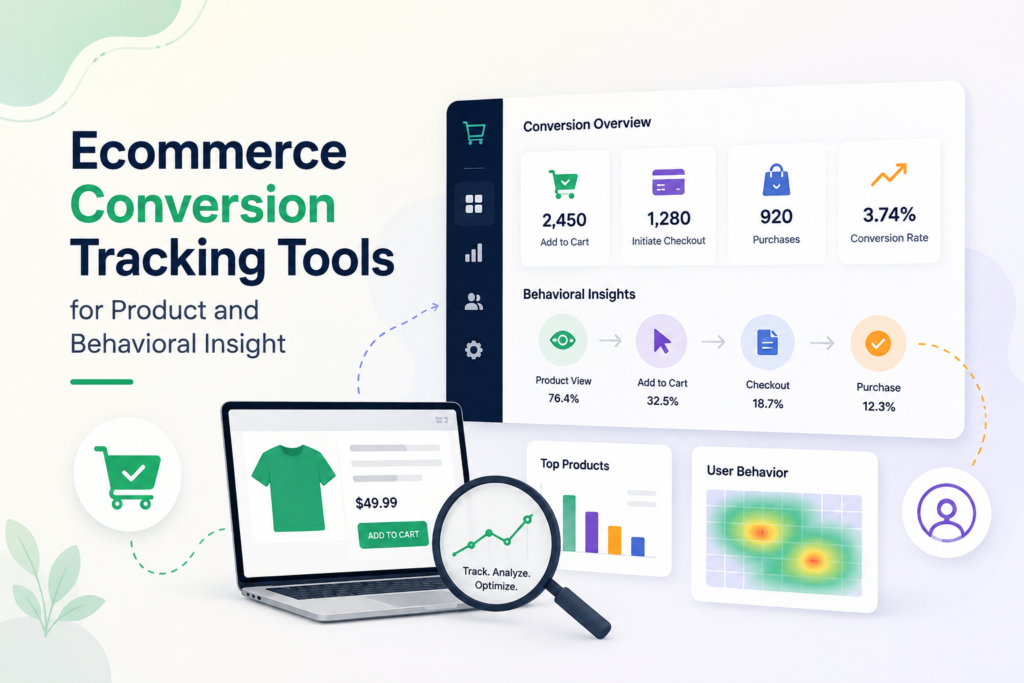
To truly improve conversion rates, you must look beyond basic traffic numbers and dive into user behavior. Behavioral evidence reveals the hidden friction between product discovery, checkout activity, and repeat purchasing. By understanding these patterns, you can make data-driven merchandising decisions that turn casual browsers into loyal customers.
“The goal is to turn data into information, and information into insight.”
Mixpanel
Overview and Best Use Case
Mixpanel is a powerful platform designed for teams that need to track granular user actions. It is best suited for stores that want to understand the “why” behind user behavior through deep funnel and retention analysis.
Key Features for Funnel and Retention Analysis
The platform excels at visualizing complex user journeys. You can easily build custom funnels to see where users drop off before completing a purchase. Its retention reports help you identify which product categories keep customers coming back over time.
Pros and Cons
The primary advantage is the depth of event-based analytics. However, the steep learning curve can be a challenge for smaller teams without dedicated data analysts.
Pricing and Ideal Store Type
Mixpanel offers a generous free tier, making it ideal for startups. Larger ecommerce brands will benefit from its scalable paid plans that support high-volume event tracking.
Heap
Overview and Best Use Case
Heap is known for its ability to capture every ecommerce conversion tracking interaction automatically. This tool is perfect for stores that want to avoid the manual setup of tracking tags for every single button click or page view.
Key Features for Automatic Event Capture
The standout feature is retroactive data collection. Once you install the snippet, Heap captures all clicks, form submissions, and page views automatically. This allows you to analyze past behavior even if you did not define the event beforehand.
Pros and Cons
You will save significant time on implementation and maintenance. The downside is that the sheer volume of data can sometimes feel overwhelming without a clear strategy to improve conversion rates.
Pricing and Ideal Store Type
Heap is best for mid-market to enterprise stores that need a “set it and forget it” solution. Its pricing is generally higher, reflecting the value of its automated data capture capabilities.
Kissmetrics
Overview and Best Use Case
Kissmetrics focuses on customer-centric tracking, linking every action to a specific person rather than just anonymous sessions. It is the go-to tool for stores prioritizing long-term customer lifetime value.
Key Features for Customer-Centric Ecommerce Tracking
The platform provides detailed individual user profiles. You can track a customer’s entire history, from their first visit to their most recent purchase, across multiple devices.
Pros and Cons
The person-based reporting is unmatched for personalized marketing. However, it requires a more robust integration process to ensure all user identifiers are captured correctly.
Pricing and Ideal Store Type
Kissmetrics is ideal for established ecommerce brands with a focus on high-touch customer relationships. Its pricing reflects its specialized focus on individual user journeys and retention.
Stop Guessing. Start Tracking.
Stop guessing which channels drive revenue. Choose a conversion tracking solution that reveals customer behavior, attribution, and performance so you can make confident marketing decisions.
Ecommerce Conversion Tracking Tools for Marketing Attribution
Understanding exactly which marketing channels drive your sales is essential to improve ecommerce conversion tracking conversion rates. Attribution tools allow you to see the full customer journey, revealing which ads assist a purchase and which ones close the deal. By shifting your budget toward high-performing channels, you can significantly boost your return on ad spend.
Triple Whale
Overview and Best Use Case
Triple Whale is a popular data platform designed specifically for Shopify brands. It acts as a central dashboard that pulls in data from your ad accounts and store backend to provide a clear view of your profitability.
Key Features for Paid Media and Shopify Reporting
The platform excels at real-time reporting for platforms like Meta, Google, and TikTok. It offers a “Pixel” that tracks customer behavior to help you improve conversion rates by identifying high-value audience segments.
Pros and Cons
The primary strength is its user-friendly interface, which makes complex data easy to digest for non-technical teams. However, some users find that it relies heavily on its own tracking pixel, which may require careful setup to ensure data accuracy.
Pricing and Ideal Store Type
Triple Whale uses a tiered pricing model based on your store’s annual revenue. It is an ideal choice for mid-market Shopify brands that need a visual, easy-to-use tool to manage daily ad performance.
Northbeam
Overview and Best Use Case
Northbeam is a sophisticated attribution platform built for brands that need deep, multi-touch insights. It is best suited for businesses that spend heavily across diverse channels and need to understand the nuance of every customer interaction.
Key Features for Multi-Touch Attribution and Media Measurement
This tool uses advanced modeling to assign credit to various touchpoints in a long sales cycle. By understanding the path to purchase, you can refine your strategy to improve conversion rates across both paid and organic traffic.
Pros and Cons
The main advantage is its highly accurate attribution engine that handles complex cross-device tracking well. The downside is a steeper learning curve and a higher price point compared to entry-level analytics tools.
Pricing and Ideal Store Type
Northbeam typically offers custom pricing based on your media spend and data volume. It is best for scaling ecommerce companies that require granular data to justify large advertising budgets.
| Feature | Triple Whale | Northbeam |
|---|---|---|
| Primary Focus | Shopify & Paid Media | Multi-Touch Attribution |
| Ease of Use | High | Moderate |
| Best For | Mid-market Shopify | High-spend scaling brands |
| Goal | Improve conversion rates | Improve conversion rates |
Ecommerce Conversion Tracking Tools for Store-Native Reporting
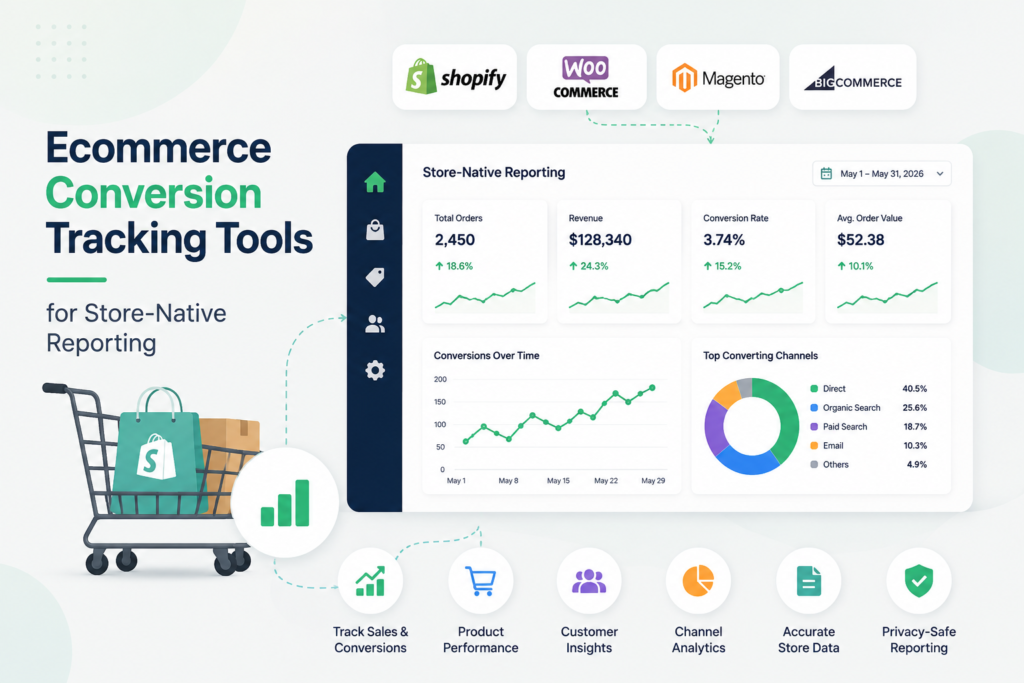
Choosing the right tool for ecommerce conversion tracking often depends on how deeply you need to integrate with your store’s backend. While third-party platforms offer advanced attribution, native reporting tools provide immediate access to your most critical transaction data without complex setups.
Shopify Analytics
Overview and Best Use Case
Shopify Analytics is the built-in dashboard designed for merchants who want a centralized view of their business performance. It is the ideal starting point for small to mid-sized stores that prioritize simplicity and direct access to order data.
Key Features for Orders, Customers, and Sales Channels
This tool excels at ecommerce conversion tracking across the entire lifecycle of an order, from the initial click to the final delivery. You can easily monitor customer behavior, segment your audience based on purchase history, and evaluate which sales channels drive the most revenue.
Pros and Cons
The primary advantage is the seamless integration with your store, requiring zero technical configuration. However, it lacks the advanced cross-platform attribution modeling found in specialized marketing tools.
Pricing and Ideal Store Type
Shopify Analytics is included with all subscription plans at no extra cost. It is best suited for businesses that operate primarily on the Shopify platform and do not require complex, multi-touch attribution data.
Glew.io
Overview and Best Use Case
Glew.io serves as a powerful bridge for merchants who need more than basic ecommerce conversion tracking reporting. It is designed for growing brands that require sophisticated online sales tracking across multiple platforms and marketing channels.
Key Features for Multichannel Ecommerce Reporting
Glew.io aggregates data from your store, social media, and email marketing into a single, cohesive dashboard. Its advanced reporting capabilities allow you to identify high-value customers and optimize your inventory based on real-time sales trends.
Pros and Cons
Users benefit from deep insights into customer lifetime value and product performance across various channels. The main drawback is the learning curve, as the platform offers a much higher level of complexity than native dashboards.
Pricing and Ideal Store Type
Glew.io offers tiered pricing based on your store’s revenue and data needs. It is the perfect solution for scaling ecommerce businesses that need to unify data from disparate sources to make data-driven growth decisions.
Feature and Pricing Comparison
Comparing the top ten solutions for ecommerce conversion tracking helps you identify the best fit for your technical and financial needs. Rather than relying on brand recognition, you should evaluate how each platform handles your specific data requirements.
Side-by-Side Comparison Table
The following table outlines the primary differences between the tools reviewed. Use this to align your selection with your store’s growth stage.
| Tool Category | Core Focus | Pricing Model | Best For |
|---|---|---|---|
| Analytics Foundations | General Traffic | Freemium | Startups |
| Behavioral Tools | User Journey | Tiered | Optimization |
| Attribution Platforms | Marketing ROI | Custom | Scale |
| Store-Native | Sales Data | Included | Simplicity |
Core Ecommerce Events and Revenue Tracking
Reliable ecommerce conversion tracking depends on how well a tool captures purchase ecommerce events. You need a system that accurately records revenue, tax, and shipping costs without data loss.
Attribution, Customer Segmentation, and Predictive Reporting
Advanced conversion tracking tools offer more than just basic numbers. Look for platforms that provide:
- Predictive analytics to forecast future customer value.
- Granular segmentation based on past purchase behavior.
- Multi-touch attribution to see which ads actually drive sales.
Integrations, Data Export, and Dashboard Options
Your chosen tool must integrate seamlessly with your existing tech stack. Ensure the platform allows for easy data exports to your CRM or data warehouse for deeper analysis.
Free Plans, Custom Pricing, and Total Cost of Ownership
Consider the long-term investment beyond the initial subscription fee. While free plans are great for testing, enterprise-level ecommerce conversion tracking often requires custom pricing based on your monthly order volume.
Ecommerce Conversion Tracking Methods and Implementation Priorities
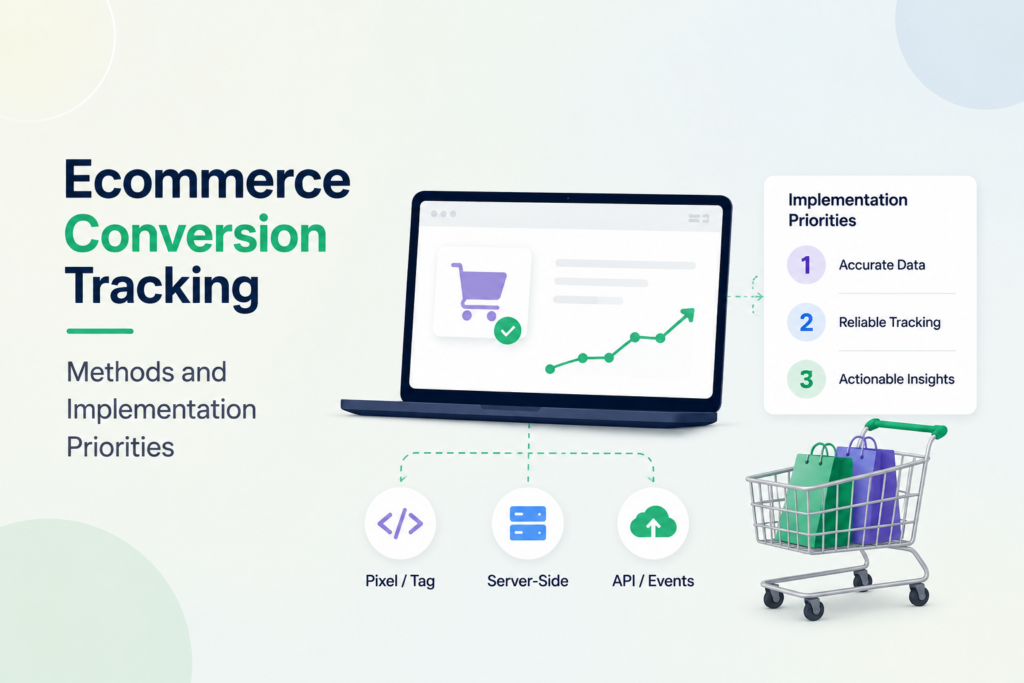
Mastering various ecommerce conversion tracking methods ensures your data remains accurate and actionable. By selecting the right technical architecture, you can capture every customer interaction across your digital storefront. This foundation is essential for understanding performance and scaling your business effectively.
Client-Side Tracking With Google Tag Manager and Platform Pixels
Most stores begin by using client-side tracking, which relies on browser-based scripts. Google Tag Manager (GTM) serves as the primary container for managing these tags without constant code changes. You deploy platform pixels for Facebook, TikTok, or Google Ads directly within the browser to fire events when users interact with your site.
While convenient, this method is susceptible to ad blockers and browser privacy restrictions. These limitations can lead to data gaps, making it difficult to see the full customer journey. You should use this approach for basic behavioral tracking while keeping more sensitive data for advanced methods.
Server-Side Tracking for More Reliable Purchase Data
Server-side tracking moves the data collection process from the user’s browser to your own server. This shift allows you to send data directly to your analytics platform, bypassing browser-level interference. Server-side implementation significantly improves data accuracy by ensuring that purchase events are captured even when users employ aggressive ad blockers.
Enhanced Conversions, Meta Conversions API, and Consent Signals
Modern privacy standards require you to handle user data with care. Enhanced Conversions and the Meta Conversions API allow you to send hashed first-party data to advertising platforms. This process helps maintain attribution accuracy while respecting user privacy and consent signals.
Testing Purchase, Refund, Checkout, and Subscription Events
You must validate your tracking setup by testing every stage of the customer lifecycle. Ensure that your system correctly records purchase, refund, checkout, and subscription events. Consistent event naming and transaction identifiers are critical for preventing duplicate data and ensuring that your reports reflect reality.
Creating a Single Source of Truth for Revenue Reporting
Establishing a single source of truth requires reconciling your analytics data against your store’s internal order records. By deduplicating events and verifying revenue values, you create a reliable dataset for all stakeholders. This level of precision is vital when you analyze how to track seo impact on ecommerce conversions, as it ensures your revenue attribution is based on verified financial outcomes.
| Tracking Method | Primary Benefit | Implementation Complexity | Data Reliability |
|---|---|---|---|
| Client-Side | Ease of setup | Low | Moderate |
| Server-Side | High accuracy | High | Excellent |
| Conversions API | Privacy compliance | Moderate | High |
How to Track SEO Impact on Ecommerce Conversions
You can unlock significant revenue growth by accurately measuring how organic search influences your ecommerce conversions. Relying solely on last-click attribution often hides the true value of your search efforts. By building a robust tracking framework, you gain a clearer picture of how search visibility drives your business forward.
Connect Google Search Console With Ecommerce Analytics
The first step is linking your Google Search Console (GSC) property directly to your analytics platform. This integration allows you to see query-level data alongside user behavior metrics. Connecting these data sources provides the foundation for understanding which search terms actually lead to site engagement.
Measure Organic Landing Pages, Assisted Conversions, and Revenue
Do not stop at simple traffic counts when evaluating your ecommerce conversion tracking organic performance. You must analyze which landing pages act as the primary entry points for high-value customers. Assisted conversions are vital here, as they reveal how organic search introduces users to your brand before they eventually purchase through other channels.
Separate Branded and Nonbranded Organic Performance
Segmenting your traffic into branded and nonbranded categories is essential for accurate reporting. Branded searches indicate existing brand awareness, while nonbranded searches show your ability to capture new market share. Tracking these separately helps you understand if your SEO strategy is effectively reaching new audiences or just capturing existing demand.
Account for Returning Visitors and Long Consideration Cycles
Ecommerce shoppers rarely buy on their first visit, especially for high-ticket items. You should monitor the time lag between the first organic touchpoint and the final transaction. Understanding these long consideration cycles prevents you from undervaluing the role of educational content in your sales funnel.
Use SEO Conversion Data to Improve Product and Category Pages
Once you identify high-performing organic pages, use that data to refine your site structure. You can improve conversion rates by optimizing internal linking from high-traffic blog posts to your most profitable category pages. Use these insights to test new merchandising layouts or update product descriptions to better match the intent of your organic visitors.
Ultimately, learning how to track seo impact on ecommerce conversions allows you to make smarter investments. By focusing on the entire customer journey, you can consistently improve conversion rates and drive sustainable growth for your online store.
Build a Smarter Tracking Setup
Build a more reliable tracking setup with tools that match your store, budget, and technical needs. Improve attribution accuracy, understand conversions, and grow profitably today.
Conclusion
Selecting the right ecommerce conversion tracking solution requires a clear view of your store platform, budget, and technical capacity. You must balance the depth of Google Analytics 4 or Adobe Analytics with the behavioral insights provided by Mixpanel or Heap. Your choice should align with your specific reporting needs and the attribution questions that drive your business growth.
Effective ecommerce conversion tracking relies on accurate event implementation and consent-aware data collection. You should prioritize revenue reconciliation and establish clear ownership of your reporting definitions across all channels. By integrating tools like Triple Whale or Northbeam, you gain a sharper perspective on how your marketing spend impacts your bottom line.
Reliable online sales tracking serves as the backbone for every major business decision you make. When you master how to track seo impact on ecommerce conversions, you unlock hidden opportunities to refine your product pages and category structures. These robust ecommerce conversion tracking methods empower you to move beyond basic metrics toward sustainable, data-driven revenue growth.
Take control of your data ecosystem today to ensure your marketing efforts yield measurable results. Consistent monitoring of your conversion tracking tools will keep your store competitive in a crowded digital marketplace. Start optimizing your setup now to turn raw traffic into long-term customer loyalty.
FAQs
What is the primary benefit of implementing robust ecommerce conversion tracking?
When you implement ecommerce conversion tracking, you move beyond basic revenue numbers to understand the specific actions that lead to a sale. It serves as the foundation for identifying which marketing channels, such as Google Ads, Meta, or Organic Search, are driving high-value customers. By using these insights, you can optimize your spend and improve conversion rates by fixing friction points in the customer journey, from initial product views to the final checkout.
Which conversion tracking tools are best for a growing Shopify or WooCommerce store?
The “best” tool depends on your specific reporting needs and technical resources. For foundational data, Google Analytics 4 is the industry standard. If you require deep behavioral insights, Mixpanel or Heap are excellent for analyzing funnels and retention. For those focused heavily on paid media attribution on Shopify, Triple Whale and Northbeam provide specialized dashboards. If you prefer a native experience, Shopify Analytics or Glew.io offer streamlined online sales tracking directly tied to your store operations.
How to track seo impact on ecommerce conversions effectively?
To understand how to track seo impact on ecommerce conversions, you should connect Google Search Console with your analytics platform. This allows you to measure organic landing pages, assisted conversions, and specific revenue generated from nonbranded searches. Instead of looking only at last-click attribution, you should analyze how organic traffic influences the top of the funnel and contributes to long-term Customer Lifetime Value, especially for shoppers with longer consideration cycles.
What are the most reliable ecommerce conversion tracking methods available today?
Modern ecommerce conversion tracking methods have shifted from simple client-side pixels to more robust solutions like server-side tracking. By using tools like Google Tag Manager server-side or the Meta Conversions API (CAPI), you can bypass browser limitations and ad blockers to ensure more accurate data. Additionally, implementing enhanced conversions helps reconcile user identity across devices, providing a clearer picture of the path to purchase.
Why should I track more than just the final transaction?
Tracking only the final sale ignores 90% of the customer journey. You should measure micro-conversions such as product views, add-to-cart events, and checkout initiation. By monitoring these stages, along with Average Order Value (AOV) and refund rates, you can identify exactly where potential customers are dropping off. This comprehensive online sales tracking approach gives you the data necessary to perform A/B testing and merchandising improvements that ultimately improve conversion rates.
How do attribution models affect my marketing decisions?
Attribution models determine which marketing touchpoint gets credit for a sale. While last-click models are common, they often undervalue “assist” channels like SEO or Email Marketing. By using multi-touch attribution tools like Northbeam or the advanced reporting in Adobe Analytics, you can see how different channels work together. This prevents you from cutting budgets for channels that may not close the sale but are vital for introducing new customers to your brand.
How can I improve the accuracy of ecommerce conversion tracking?
Improving data accuracy starts with validating every stage of the customer lifecycle. You should test purchase, refund, checkout, and subscription events to ensure they are recorded correctly and transaction identifiers are consistent. Reconciling analytics data against your store’s internal order records also helps identify duplicate events, missing revenue, and reporting discrepancies.
What ecommerce events should I track for my online store?
You should track key events throughout the customer journey, including product views, add-to-cart actions, initiated checkouts, completed purchases, refunds, and subscriptions. Monitoring these events helps you identify where customers drop off and provides a clearer understanding of how visitors move from product discovery to completed transactions.
Is server-side tracking better for ecommerce conversion tracking?
Server-side tracking can provide more reliable purchase data because it moves data collection from the user’s browser to your own server. This helps reduce the impact of browser restrictions and ad blockers and can improve the accuracy of purchase event reporting. For stores with more advanced tracking requirements, server-side tracking can complement client-side tracking and platform pixels.
How do I create a single source of truth for ecommerce revenue?
Creating a single source of truth requires comparing your analytics data with your store’s internal order records. You should reconcile revenue values, deduplicate events, and verify transaction data across your tracking platforms. This creates a more reliable dataset for analyzing marketing performance, attribution, and revenue growth.
2 thoughts on “Ecommerce Conversion Tracking Tools: 10 Best Options Compared”