
Are you certain that every dollar of your advertising budget is actually driving growth, or is your money quietly disappearing into ineffective campaigns? Many marketers struggle to identify hidden leaks in their digital strategy, often missing simple opportunities to boost performance.
Performing a professional PPC Audit is the most effective way to regain control of your account health. By systematically reviewing your settings and targeting, you can eliminate waste and scale your return on investment with confidence.
This comprehensive ppc audit guide provides a clear roadmap to help you navigate the complexities of modern advertising. We will walk you through every critical stage of the process to ensure your campaigns remain competitive in the United States market.
Key Takeaways
- Identify and eliminate wasted ad spend to improve your overall ROI.
- Ensure your account settings align with current industry best practices.
- Discover hidden opportunities to scale high-performing keywords and ads.
- Maintain consistent account health throughout the entire fiscal year.
- Gain a competitive edge by refining your targeting and bidding strategies.
Get a Professional PPC Audit Today
Uncover wasted ad spend, improve campaign performance, and receive expert recommendations that increase conversions, lower acquisition costs, and maximize your advertising return on investment.
What is the Importance of a Regular PPC Audit?
Conducting a regular PPC Audit is the most effective way to ensure your marketing dollars are working as hard as you are. Without a systematic review, your account can quickly accumulate wasted spend on irrelevant clicks or outdated strategies. By performing these checks, you identify hidden opportunities for growth that might otherwise remain buried under layers of historical data.
A comprehensive ppc audit guide helps you stay aligned with current market trends and your specific business objectives. When you evaluate your account performance, you prevent the gradual degradation of results that often happens when campaigns are left on autopilot. This proactive approach ensures that your bidding strategies and targeting remain sharp in a competitive landscape.
Establishing a routine audit schedule is a fundamental best practice for any digital marketer. It allows you to pivot quickly when search behaviors change or when new competitors enter your space. Consider the following comparison to understand why consistent oversight is vital for your long-term success.
| Audit Frequency | Performance Impact | Risk Level |
|---|---|---|
| Monthly | High Optimization | Low |
| Quarterly | Moderate Growth | Medium |
| Annually | Stagnant Results | High |
Ultimately, a PPC Audit serves as your primary defense against inefficiency. By dedicating time to this process, you transform your account from a static expense into a dynamic engine for revenue. Consistent monitoring is the hallmark of a professional strategy that delivers measurable results over time.
Preparing Your Account for a Comprehensive Review
Success in digital advertising starts long before you look at your first campaign metric. Before you begin a ppc audit, you must ensure that your digital house is in order. This preparation phase prevents data gaps and ensures that your analysis rests on a solid foundation of reliable information.
Gathering Necessary Access and Historical Data
You cannot evaluate what you cannot see. Start by verifying that you have full administrative access to all advertising platforms, including Google Ads, Microsoft Advertising, and your analytics software. Without these permissions, you may find yourself blocked from critical settings or reporting features during your ppc audit.
Once access is secured, focus on collecting the right historical data sets. You should aim to gather at least 90 days of performance history to account for seasonal trends and algorithm fluctuations. Consider organizing your documentation into the following categories:
- Account Hierarchy: A map of your current campaign structure.
- Budget Logs: Records of past spending adjustments.
- Creative Assets: A library of current ad copy and visual elements.
- Conversion Data: Historical reports on lead or sales volume.
Defining Your Key Performance Indicators
Defining your success metrics is the final step in your preparation. You must align your ppc audit with your specific business objectives to ensure the findings are actionable. If you do not know what “good” looks like, you will struggle to identify areas for improvement.
“Measurement is the first step that leads to control and eventually to improvement. If you can’t measure it, you can’t improve it.”
To keep your review focused, prioritize these essential performance indicators:
| Metric | Purpose | Target |
|---|---|---|
| Conversion Rate | Efficiency | Industry Average |
| Cost Per Acquisition | Profitability | Target Margin |
| Click-Through Rate | Relevance | Historical Baseline |
By establishing these benchmarks early, you create a clear framework for your evaluation. This proactive approach ensures that every change you implement later is backed by data rather than guesswork.
Evaluating Account Structure and Campaign Settings
Your campaign hierarchy serves as the blueprint for your entire digital advertising strategy. A well-organized account is the backbone of success, directly impacting your ability to manage and scale campaigns effectively. During a ppc audit, you must verify that your setup supports your long-term business objectives rather than hindering them.
Analyzing Campaign Hierarchy and Naming Conventions
A logical structure allows you to navigate your account with ease. You should ensure that your campaigns are grouped by product category, service type, or specific marketing goals. Consistent naming conventions are equally vital for quick identification and reporting.
Avoid generic names like “Campaign 1.” Instead, use a descriptive format that includes the campaign type, target region, and product line. This clarity saves time during your ppc audit and helps team members understand the account layout instantly.
Reviewing Geographic and Network Targeting
Even the best ads will fail if they appear in front of the wrong people. You must review your geographic settings to confirm that your ads are only serving in locations where you can fulfill orders or provide services. Excluding irrelevant regions prevents wasted spend and improves your overall return on investment.
Furthermore, check your network settings to see if you are opted into the Google Display Network when you only intended to target Search. Misaligned network settings often lead to low-quality traffic that drains your budget. Ensuring these settings are tight is a critical step in any professional ppc audit.
Checking Budget Allocation and Bidding Strategies
Your budget should be distributed based on the performance and priority of each campaign. If high-converting campaigns are limited by budget, you are likely missing out on valuable sales. You must align your bidding strategy with your specific conversion goals to maximize efficiency.
| Strategy Component | Best Practice | Audit Focus |
|---|---|---|
| Campaign Naming | Descriptive & Consistent | Ease of navigation |
| Geographic Reach | Specific & Relevant | Eliminate wasted spend |
| Bidding Model | Goal-Oriented | Maximize conversions |
| Network Settings | Intent-Based | Traffic quality |
Finally, evaluate whether your automated bidding strategies are actually meeting your targets. Sometimes, manual adjustments are necessary to regain control during a ppc audit. By confirming that your budget flows toward your most profitable segments, you ensure your account remains highly optimized for growth.
Performing a Deep Dive into Keyword Performance
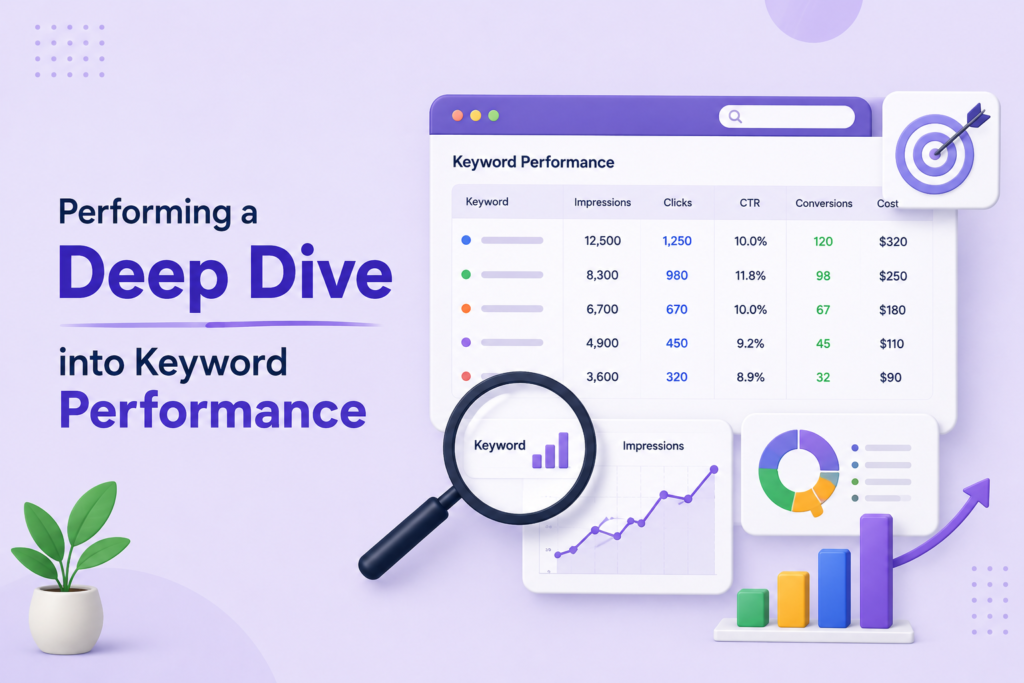
A successful ppc audit hinges on your ability to refine and optimize your keyword strategy. Keywords act as the primary drivers of your traffic, making them a critical focal point for any thorough review of your account health.
Identifying Underperforming and Negative Keywords
You must regularly scan your account for terms that consume budget without delivering conversions. These underperforming keywords often have high impressions but low click-through rates or high costs per acquisition.
To improve your efficiency, consider these steps:
- Pause keywords that have spent significant budget with zero conversions.
- Add negative keywords to prevent your ads from showing for irrelevant searches.
- Review your Quality Score to see if low-performing terms are dragging down your account.
Assessing Keyword Match Type Distribution
A healthy account maintains a strategic balance between reach and precision. Relying too heavily on broad match types can lead to wasted spend, while being too restrictive with exact match might limit your growth potential.
Evaluate your current distribution to ensure it aligns with your business goals. Strategic match type management allows you to capture high-intent traffic while maintaining control over your costs during your ongoing ppc audit.
Analyzing Search Query Reports for Irrelevant Traffic
The search query report is your most valuable tool for uncovering what users actually type into search engines. By reviewing this data, you can identify hidden opportunities and eliminate irrelevant traffic that drains your resources.
Focus on these key areas when analyzing your reports:
- Identify search terms that do not align with your product or service offerings.
- Look for long-tail variations that could be added as new, high-performing keywords.
- Use the data to refine your negative keyword lists and tighten your targeting parameters.
Optimizing Ad Copy and Creative Assets
When conducting a thorough ppc campaign analysis, your creative assets often reveal the most significant opportunities for growth. Your ad copy serves as the digital storefront for your business, demanding constant refinement to capture attention. By focusing on these elements, you ensure that your brand message resonates with the right audience at the right time.
Maximize Every Advertising Dollar
Our PPC specialists analyze your campaigns, optimize bidding strategies, refine targeting, and help you achieve better results with a smarter, data-driven advertising approach.
Testing Ad Relevance and Quality Score Impact
Ad relevance is a critical component of your Quality Score, which directly influences your cost-per-click and ad positioning. You must ensure that your headlines and descriptions align perfectly with the user’s search intent. When your ad copy mirrors the keywords being searched, you create a seamless experience that encourages higher engagement.
Regularly testing different variations of your copy allows you to identify which messages drive the best results. Continuous experimentation is the hallmark of a successful ppc campaign analysis. By monitoring how changes impact your Quality Score, you can refine your strategy to favor high-performing, relevant content.
Reviewing Call-to-Action Effectiveness
A strong call-to-action (CTA) acts as the final nudge that turns a curious searcher into a valuable lead. You should audit your CTAs to ensure they are clear, urgent, and action-oriented. Phrases like “Get Your Free Quote” or “Shop the Sale Now” often outperform generic buttons by providing a clear path forward for the user.
If your conversion rates are stagnant, your CTA might be the culprit. Test different verbs and value propositions to see which language motivates your specific audience. A well-crafted CTA is essential for driving meaningful user engagement across all your digital platforms.
Auditing Ad Extensions and Asset Utilization
Ad extensions provide extra information that helps your ads stand out on the search engine results page. By utilizing sitelinks, callouts, and structured snippets, you effectively maximize the real estate your ads occupy. This increased visibility often leads to higher click-through rates and improved overall performance.
During your audit, verify that all active extensions are relevant to the specific campaign goals. Removing outdated or irrelevant assets ensures that your messaging remains fresh and professional. Proper asset utilization is a vital step in any comprehensive ppc campaign analysis, as it allows you to provide more value to the user before they even click your link.
Analyzing Landing Page Experience and Conversion Paths
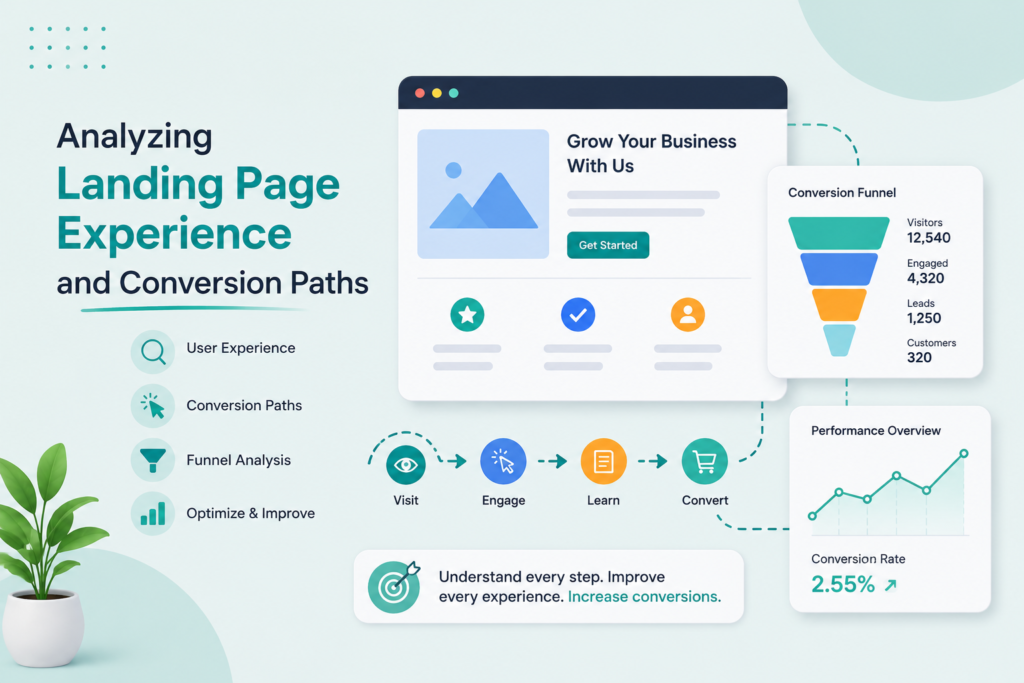
A successful ad click represents the beginning of a critical conversion path. While your ads might drive high traffic, the landing page experience ultimately determines whether a visitor converts into a customer. A thorough ppc campaign analysis must look beyond the ad platform to evaluate what happens once the user arrives at your website.
Checking Page Load Speed and Mobile Responsiveness
Modern users expect instant results when they click on an advertisement. If your page takes more than three seconds to load, you will likely see a significant increase in bounce rates. Technical performance is a non-negotiable factor in your overall strategy.
Furthermore, your site must be fully optimized for mobile devices. Since a large portion of traffic originates from smartphones, a non-responsive design will frustrate potential customers. You should prioritize these technical elements to ensure a smooth user experience across all devices.
Verifying Message Match Between Ads and Landing Pages
Message match refers to the consistency between the language in your ad copy and the content on your landing page. When a user clicks an ad promising a specific discount or solution, they expect to see that same offer immediately upon arrival. A lack of alignment often leads to confusion and lost sales.
You can improve your conversion rates by ensuring that your headlines and calls-to-action mirror the intent of your ads. This creates a seamless transition that builds trust with your audience. Consistent messaging is a core component of a successful ppc campaign analysis.
| Factor | Impact on Conversion | Optimization Priority |
|---|---|---|
| Page Load Speed | High | Critical |
| Mobile Responsiveness | High | Critical |
| Message Match | Medium | High |
| Visual Hierarchy | Low | Medium |
By auditing these specific areas, you can identify bottlenecks that prevent users from completing their journey. Consistent monitoring of these metrics will help you maintain a competitive edge in your market.
Verifying Conversion Tracking and Analytics Integration
Reliable data is the lifeblood of any effective ppc campaign analysis, guiding your future decisions and budget allocations. Without precise tracking, your efforts to measure performance will likely fall short of expectations. You must verify your tracking setup to ensure every dollar spent provides clear, actionable insights into your return on investment.
Ensuring Accurate Pixel and Tag Implementation
The first step in your audit involves confirming that your tracking pixels are firing correctly across your website. Using tools like Google Tag Manager (GTM) allows you to manage these tags without constant developer intervention. You should verify that your base tags and conversion triggers are active on all relevant landing pages.
Consistency is key when deploying these scripts. If a tag fails to fire on a specific page, your data will be incomplete, leading to skewed results. Regularly test your implementation using browser extensions to ensure the data layer is capturing the correct information during user interactions.
Validating Goal Tracking in Google Analytics 4
Once your tags are active, you must validate that these actions are correctly recorded as conversions within Google Analytics 4. Unlike older versions, GA4 relies heavily on event-based tracking to measure user engagement. You need to ensure that your key business objectives are marked as conversions in the admin dashboard.
To maintain high data integrity, follow this verification checklist:
- Check GTM Preview Mode: Confirm that tags fire when a user completes a desired action.
- Review Real-Time Reports: Verify that GA4 is receiving live data from your website traffic.
- Audit Conversion Paths: Ensure that the attribution models align with your current ppc campaign analysis goals.
- Test Cross-Domain Tracking: Confirm that user sessions remain intact if your traffic moves between different subdomains.
By performing this thorough ppc campaign analysis of your tracking infrastructure, you protect your business from making decisions based on faulty metrics. Accurate tracking empowers you to scale high-performing campaigns while cutting waste from underperforming assets.
Assessing Audience Targeting and Remarketing Lists
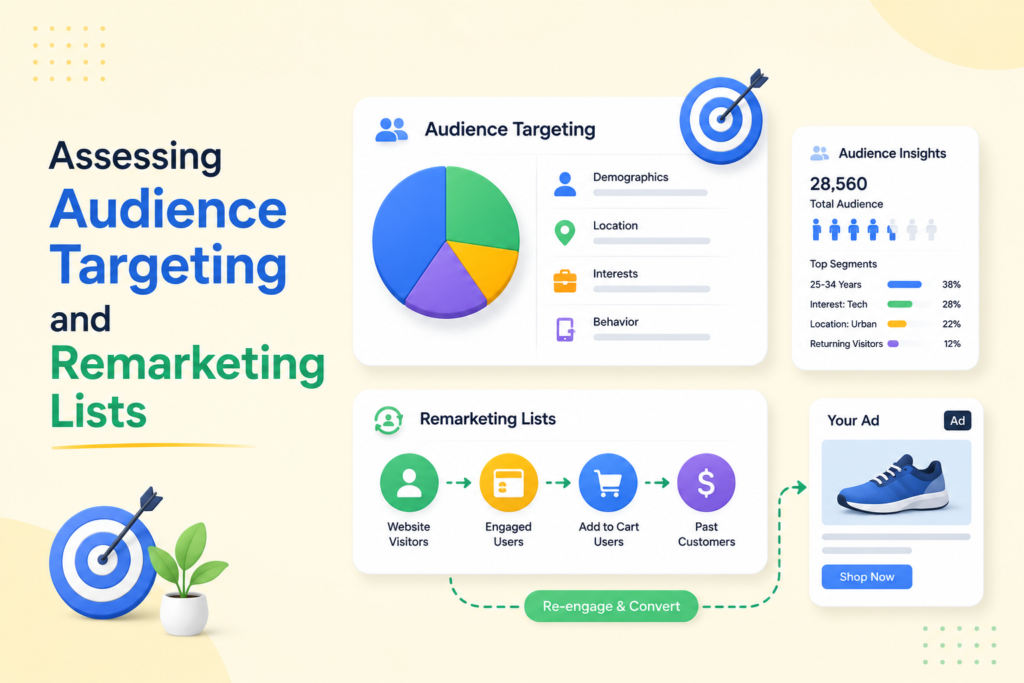
During a comprehensive pay-per-click audit, you must evaluate how your audience targeting influences your bottom line. Refining your reach through precise segments allows you to focus your budget on users who are most likely to convert. This strategic assessment helps you tailor your messaging to specific user behaviors and improve your overall campaign efficiency.
Reviewing Audience Segment Performance
You should begin by analyzing which audience segments provide the highest value for your business. Identifying top-performing groups allows you to shift your budget toward demographics or interests that consistently drive conversions. It is essential to remove segments that drain your resources without delivering meaningful results.
When conducting your pay-per-click audit, look for patterns in conversion rates across different age groups, locations, and device types. By isolating these variables, you can create more personalized ad experiences. This data-driven approach ensures that your marketing spend remains highly effective.
Evaluating Remarketing List Sizes and Exclusions
Remarketing lists are powerful tools, but they require regular maintenance to remain effective. You must ensure that your lists are large enough to meet platform requirements while remaining relevant to your current goals. If a list is too small, your ads may struggle to gain traction in the auction.
Equally important is the implementation of strategic exclusions to prevent unnecessary ad fatigue. By excluding users who have already converted or those who are not part of your target demographic, you protect your brand reputation. A well-maintained pay-per-click audit process keeps your remarketing efforts fresh and engaging for your audience.
| Audience Segment | Conversion Rate | Budget Allocation | Action Required |
|---|---|---|---|
| Past Purchasers | High | Increased | Maintain |
| Cart Abandoners | Medium | Optimized | Refine Creative |
| General Visitors | Low | Decreased | Exclude/Review |
Reviewing Competitive Landscape and Auction Insights
A thorough review of your competitive landscape reveals hidden gaps in your strategy. When you perform a pay-per-click audit, you must look beyond your own account metrics to see how you stack up against others. Understanding your position relative to industry rivals is a critical component of long-term success.
Comparing Impression Share Against Competitors
The Auction Insights report is your most valuable tool for benchmarking performance. It allows you to see exactly how often your ads appear compared to your main competitors for the same search terms. By tracking your impression share, you can identify if you are losing visibility due to budget constraints or low ad rank.
If your impression share is lower than expected, you might be missing out on high-intent traffic. Use this data to determine if your competitors are bidding more aggressively or if your quality scores need improvement. A consistent pay-per-click audit helps you pinpoint these specific areas of weakness.
Identifying Opportunities for Market Share Growth
Once you understand where you stand, you can shift your focus toward capturing more market share. Strategic bidding adjustments often allow you to outrank competitors during peak hours or for high-value keywords. You should also consider refining your ad positioning to ensure your brand remains top-of-mind for your target audience.
Proactive adjustments to your campaign settings can help you maintain a dominant presence in your industry. By regularly monitoring the competitive landscape, you stay ahead of market shifts and capitalize on new opportunities. The following table outlines key metrics to track during your next review:
| Metric | Purpose | Actionable Insight |
|---|---|---|
| Impression Share | Visibility measurement | Increase budget if lost due to rank |
| Overlap Rate | Direct competition | Adjust bids for high-overlap keywords |
| Outranking Share | Competitive dominance | Improve ad copy to boost CTR |
| Top of Page Rate | Ad placement | Optimize landing pages for better rank |
Incorporating these insights into your pay-per-click audit ensures that your strategy remains data-driven and competitive. Always look for ways to turn these insights into actionable growth for your business.
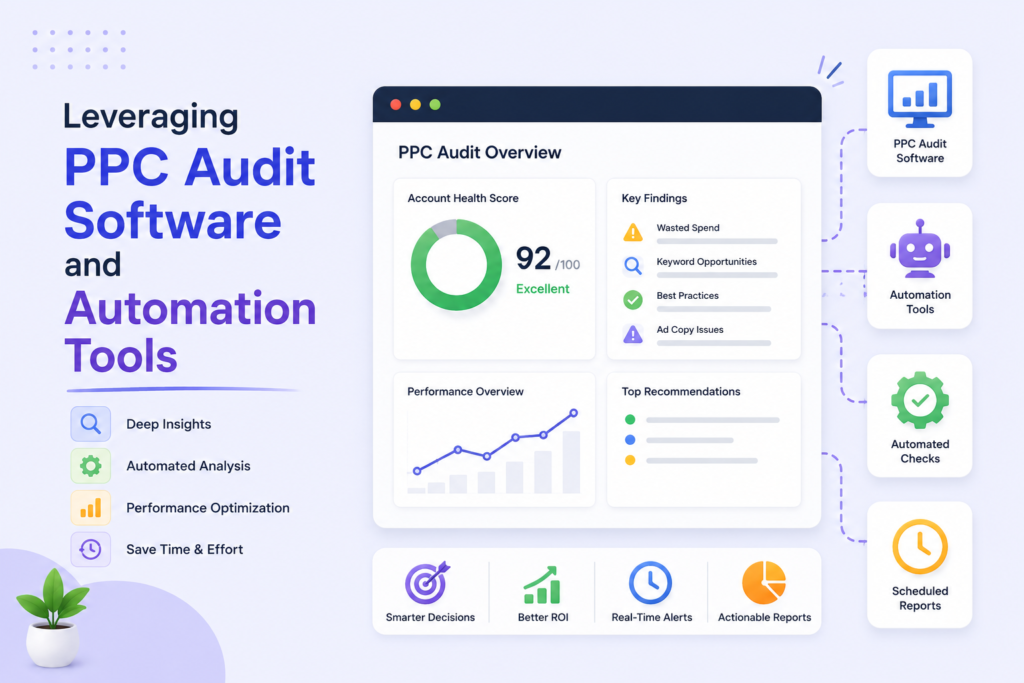
Leveraging PPC Audit Software and Automation Tools
You can significantly enhance your campaign management by integrating advanced technology into your daily workflow. Relying solely on manual checks often leads to missed opportunities and oversight. By incorporating a structured pay-per-click audit into your routine, you ensure that your data remains accurate and your strategies stay aligned with your business goals.
Selecting the Right Tools for Data Visualization
Effective data visualization transforms complex metrics into clear, actionable insights. When you choose the right ppc audit software, you gain the ability to spot trends that are otherwise hidden in spreadsheets. Visual dashboards allow you to communicate performance results to stakeholders with much greater ease and precision.
Look for platforms that offer customizable reporting features tailored to your specific KPIs. High-quality tools provide a centralized view of your account health, which helps you make faster, data-driven decisions. This clarity is essential for maintaining a competitive advantage in a crowded digital marketplace.
Automating Routine Maintenance Tasks
Automation serves as a powerful ally in reducing the time spent on repetitive account chores. By utilizing specialized ppc audit software, you can set up alerts for budget pacing, keyword anomalies, and landing page errors. This proactive approach helps you minimize human error while freeing up your schedule for high-level strategy development.
Automated scripts and rules ensure that your account remains optimized even when you are not actively monitoring it. Integrating these technologies into your pay-per-click audit process guarantees that you remain efficient and agile. Ultimately, these tools empower you to focus on growth rather than getting bogged down in daily maintenance tasks.
Implementing Changes and Monitoring Results
Turning audit data into actual results requires a strategic approach to implementation and ongoing monitoring. You must move beyond simple observation to create a roadmap that drives measurable growth for your business.
Prioritizing Audit Findings by Impact
Not every issue you uncover carries the same weight. You should prioritize your findings based on their potential impact on your bottom line and the effort required to fix them.
Focus first on high-impact changes, such as adjusting budget allocations or pausing wasted spend on irrelevant search terms. Whether you handle these tasks in-house or choose to hire professional ppc audit services, having a clear execution plan is essential for success.
Establishing a Post-Audit Testing Schedule
Optimization is an ongoing process rather than a one-time event. You need to establish a consistent testing schedule to monitor how your changes influence key performance metrics over time.
Even if you started your journey with a free ppc audit, the long-term health of your account depends on your ability to iterate. Use A/B testing for ad copy and landing pages to ensure your account continues to evolve alongside changing market conditions.
Regularly reviewing your data allows you to refine your strategy and maintain a competitive edge. Consistency is the key to turning initial insights into sustained profitability for your campaigns.
Ready to Scale Your PPC Performance?
Discover hidden growth opportunities, strengthen campaign performance, improve Quality Scores, and build a profitable PPC strategy designed to deliver consistent long-term business success.
Conclusion
A consistent PPC Audit serves as the most effective way to ensure your advertising budget works as hard as possible for your business. You gain clarity on where your capital goes and how it impacts your bottom line.
Following the steps in this guide allows you to improve your account health systematically. You will drive better results across all your campaigns by maintaining this rigorous standard of oversight.
You might choose to manage this process internally to keep your team sharp. You could also engage professional ppc audit services to gain an objective perspective from industry experts at agencies like WordStream or Tinuiti.
The commitment to regular review separates top-performing accounts from the rest of the market. Your dedication to a thorough PPC Audit creates a sustainable path toward long-term profitability.
Start your review today to unlock new growth opportunities. You will maintain a strong competitive advantage by keeping your strategy aligned with current search trends and platform updates.
FAQs
What exactly is a PPC audit and why does my account need one?
A ppc audit is a comprehensive, systematic review of your entire advertising account designed to identify inefficiencies, wasted spend, and growth opportunities. By following a professional ppc audit guide, you ensure that your account remains healthy and your strategies stay aligned with the latest trends in the United States market, preventing performance decay over time.
How frequently should I perform a pay-per-click audit on my campaigns?
For most businesses, conducting a pay-per-click audit at least once per quarter is a fundamental best practice. Regular reviews allow you to catch issues with Quality Score, adjusting for shifts in the competitive landscape on platforms like Google Ads and Microsoft Advertising before they impact your long-term ROI.
What are the primary benefits of investing in professional ppc audit services?
Professional ppc audit services provide an unbiased, expert perspective on your account that internal teams might miss. Experts can perform a deeper ppc campaign analysis, identifying complex technical issues in your Google Analytics 4 setup or nuances in your bidding strategies that directly influence your bottom line.
Can I use ppc audit software to automate this process?
Yes, utilizing ppc audit software like Optmyzr or Adzooma can significantly streamline your workflow. These tools are excellent for data visualization and automating routine maintenance, allowing you to focus your energy on high-level strategic decisions and creative optimizations revealed during your pay-per-click audit.
Is a free ppc audit actually worth the time for a growing business?
A free ppc audit can serve as an excellent diagnostic starting point to identify “low-hanging fruit” and immediate red flags in your account. While it may not be as exhaustive as a manual deep dive, it provides a high-level ppc campaign analysis that highlights where your budget is being wasted and where you should focus your optimization efforts.
What should I prioritize after completing my ppc campaign analysis?
After completing your ppc campaign analysis, you should prioritize findings based on their potential impact on your conversion goals and budget efficiency. Start by fixing broken conversion tracking, implementing critical negative keywords, and refining your landing page message match before moving on to more granular adjustments like ad extension testing.
How does a ppc audit guide help me stay competitive?
A structured ppc audit guide provides a roadmap for evaluating your impression share against market rivals. By analyzing Auction Insights, you can identify exactly where competitors are outperforming you and adjust your targeting and budget allocation to reclaim valuable market share.
How long does a typical PPC audit take to complete?
A basic PPC audit for a small account can often be completed in a few hours, while larger multi-campaign accounts may require several days of detailed analysis. The timeline depends on the number of campaigns, keywords, ad groups, conversion actions, and integrations that need to be reviewed across platforms such as Google Ads and Microsoft Advertising.
Which metrics should I focus on during a PPC audit?
The most important metrics to review include click-through rate (CTR), conversion rate, cost per conversion, return on ad spend (ROAS), Quality Score, impression share, and search term relevance. These indicators help reveal whether your campaigns are attracting the right audience and converting traffic efficiently while maintaining profitable acquisition costs.
Should I audit my landing pages as part of a PPC audit?
Yes, a complete PPC audit should include a review of landing page relevance, load speed, mobile usability, and message match with your ads. Even highly optimized campaigns can underperform if visitors encounter a slow or confusing landing page, so evaluating the post-click experience is essential for improving conversions and maximizing the value of your advertising budget.