
Have you ever looked at a PPC campaign and thought, “How did I get hundreds of clicks but barely any real leads?”
That question is more important than it looks.
A sudden spike in clicks does not automatically mean click fraud. It could be a successful campaign, a poorly matched audience, accidental clicks, bots, competitors, click farms, or another form of invalid traffic. The difficult part is figuring out which clicks are genuine and which ones are quietly consuming your advertising budget.
That is where click fraud prevention software comes into the picture.
I approached this comparison from the perspective of a marketer who wants something practical rather than another list of tools with five-star ratings and vague claims. I reviewed the current product information, feature pages, documentation, pricing information where publicly available, and the way each platform says it approaches invalid traffic.
One important note before we get into the list: I did not personally run a live paid campaign through all 10 platforms or independently reproduce every vendor’s detection claims. So when I discuss detection accuracy, coverage, or savings, I identify those as vendor-reported capabilities rather than presenting them as my own laboratory results.
That distinction matters because fraud-prevention vendors naturally highlight their strongest results.
The real question is not simply “Which tool says it blocks the most fraud?”
It is:
Which tool gives you the right combination of detection, prevention, visibility, integrations, control, and cost for the way you actually buy traffic?
That is what I am trying to answer here.
Key Takeaways
- ClickCease is a strong option for advertisers looking for established PPC fraud monitoring and automated protection across Google, Meta, and Microsoft.
- Lunio stands out for marketers who want machine-learning-based traffic analysis and automatic exclusions across multiple advertising platforms.
- TrafficGuard is particularly interesting for advertisers running campaigns across search, social, affiliate, and mobile environments.
- ClickGuard and ClickPatrol are worth considering when you want granular protection controls and detailed click-level analysis.
- Linkstrackly has a different but useful role: it can give marketers the click-tracking visibility needed to investigate suspicious traffic patterns instead of relying only on a black-box fraud score.
Track Your Clicks Before They Become a Problem
Start tracking campaign clicks with Linkstrackly to uncover unusual traffic patterns, understand your sources, and make smarter decisions before wasted advertising spend grows.
What Is Click Fraud Prevention Software?
At its simplest, click fraud prevention software is designed to identify suspicious or invalid interactions with paid advertising and help prevent those interactions from wasting advertising budget.
That sounds straightforward, but there is an important distinction between click tracking, click fraud detection, and click fraud prevention. For advertisers managing significant PPC budgets, click fraud prevention software can provide an additional layer of protection beyond standard campaign analytics.
A normal analytics or tracking platform can tell you that somebody clicked a link.
A fraud-detection system tries to determine whether that click looks legitimate.
A prevention platform goes one step further by taking some form of action against traffic considered fraudulent or invalid.
That action might involve:
- Blocking or excluding an IP address
- Excluding an audience
- Blocking a device or traffic source
- Updating advertising-platform exclusions
- Preventing advertising pixels from firing
- Flagging suspicious activity for investigation
- Removing fraudulent traffic from campaign optimization
- Providing evidence for investigating wasted ad spend
The right click fraud prevention software can combine several of these actions instead of forcing marketers to manage them manually. This is why I would not automatically call every click tracker click fraud prevention software.
A tracker can provide the evidence you need to spot a problem without actually preventing the next fraudulent click.
That difference becomes particularly important for businesses spending thousands of dollars every month on Google Ads, Microsoft Ads, Meta Ads, LinkedIn Ads, or other paid channels.
Why Does Click Fraud Matter?
Imagine that you spend $10,000 per month on paid advertising.
You notice that traffic is increasing, but qualified leads are not.
Your first instinct might be to change:
- Keywords
- Ad copy
- Landing pages
- Bids
- Audiences
- Geographic targeting
- Conversion goals
But what if part of the problem is the traffic itself?
If a meaningful portion of your clicks comes from bots, competitors, click farms, automated systems, or other low-quality sources, you may be optimizing campaigns based on bad data.
That creates two problems.
First, you may pay for traffic that has little or no chance of becoming a customer.
Second, the bad traffic can contaminate the data you use to make marketing decisions. This is another reason click fraud prevention software can be valuable for performance-focused marketing teams.
This is one of the biggest click fraud prevention software benefits that I think marketers sometimes overlook: the value is not only in potentially saving ad spend. It can also be about getting a cleaner view of campaign performance.
How I Evaluated These Click Fraud Prevention Software Tools
I did not want to create another generic “10 best tools” article. When evaluating click fraud prevention software, I wanted to focus on how useful each platform could be in a real advertising workflow.
Instead, I looked at each platform through the questions I would ask before putting it anywhere near a real advertising account.
My evaluation criteria
| Factor | What I looked for |
|---|---|
| Fraud detection | How the platform identifies suspicious traffic |
| Prevention | Whether it can actively block or exclude bad traffic |
| Ad platforms | Google, Meta, Microsoft and other supported channels |
| Traffic visibility | How much information marketers can see |
| Behavioral analysis | Whether behavior is part of the detection process |
| Reporting | Whether the platform provides actionable reporting |
| Automation | Whether exclusions or protection can happen automatically |
| Tracking | Whether click-level information is available |
| Ease of implementation | How difficult setup appears to be |
| Pricing | Public pricing where available |
| Best fit | The type of advertiser most likely to benefit |
I also paid attention to whether a platform is primarily designed for PPC protection, broader ad fraud, bot management, or fraud recovery.
That distinction matters.
Not every product on this list is identical, and I would not recommend buying the most expensive platform simply because it has the longest feature list.
1. ClickCease: Strong All-Around PPC Fraud Protection
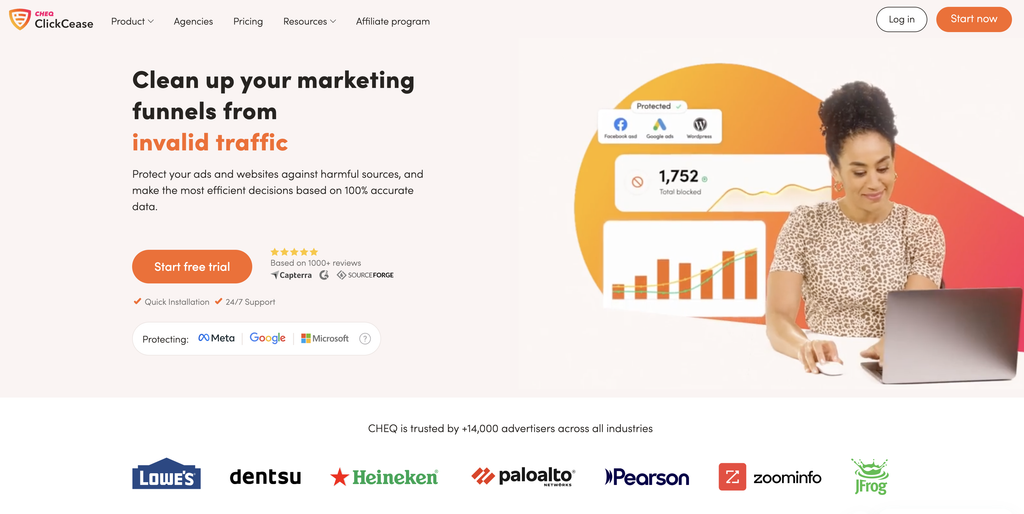
Best for: SMBs, agencies, and advertisers wanting established PPC fraud protection.
If somebody asked me to name one of the most recognizable products in this category, ClickCease would be near the top of my list.
ClickCease says it monitors paid traffic from Google, Meta, and Microsoft Ads and evaluates visitors using more than 2,000 behavioral and technical tests. It also provides automatic exclusion capabilities designed to prevent fraudulent users from continuing to interact with campaigns.
That makes ClickCease a fairly straightforward example of what people expect from click fraud prevention software.
What I like about ClickCease
The biggest strength is that the product is focused directly on advertising fraud rather than making you build your own fraud-analysis workflow from general analytics data. For marketers who want dedicated click fraud prevention software, that focused approach can be a significant advantage.
Its current plans include protection for Google, Meta, and Microsoft Ads, with features such as audience exclusion and automated protection. ClickCease also says it is approved to use Google and Meta APIs.
Another useful feature is its emphasis on behavioral analysis.
Instead of relying on one signal such as IP address, the platform says it evaluates more than 2,000 signals when analyzing visits.
That is important because an IP address by itself is not necessarily evidence of fraud.
A shared office, VPN, mobile network, or household can produce multiple users behind the same address.
Potential drawback
The pricing is not the cheapest entry point for every advertiser. Current published plans begin at $69/month when billed annually for the Starter plan, with higher tiers for additional websites and traffic.
For a small advertiser spending only a few hundred dollars per month, that needs to be considered carefully. Before investing in click fraud prevention software, smaller advertisers should make sure the expected savings justify the monthly cost.
My verdict
ClickCease is one of the safer starting points for advertisers who want a dedicated solution rather than building their own monitoring system.
Rating for practical use: 8.8/10
2. Lunio: Strong Choice for Multi-Platform Advertisers
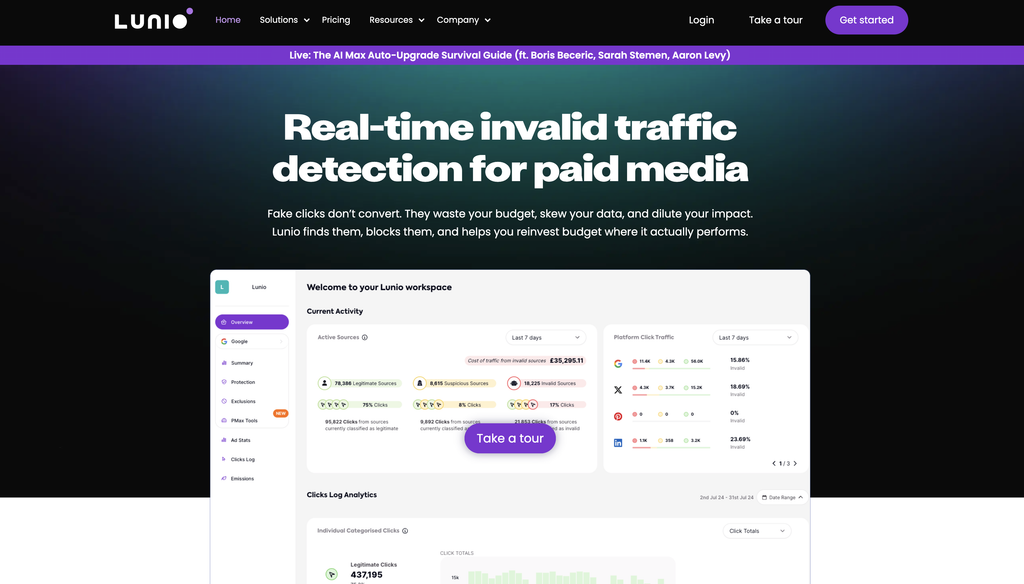
Best for: Performance marketers and businesses running paid traffic across multiple channels.
Lunio takes an interesting approach because it positions invalid traffic as a marketing performance problem, not simply a cybersecurity issue.
The platform says its machine-learning system analyzes ad click behavior in real time and classifies users as legitimate, suspicious, or invalid. It also provides click analytics and automatic exclusions across advertising platforms.
That combination is what makes Lunio interesting to me. For advertisers managing multiple channels, click fraud prevention software can make it easier to monitor traffic quality across campaigns.
The best click fraud prevention software should not just tell you, “These clicks are bad.”
It should help you understand where those clicks came from and what happens after detection.
What I like about Lunio
The click analytics component is particularly relevant for marketers.
Lunio says it helps users identify the sources of invalid traffic and track traffic quality over time. Its platform can also automatically exclude invalid users from advertising platforms.
That makes it useful for campaigns where traffic quality changes frequently.
For example, imagine a campaign suddenly begins receiving a large volume of clicks from a source that historically generated high-quality leads.
Instead of immediately assuming the campaign is broken, you can investigate whether the traffic itself changed.
Potential drawback
Lunio can make more sense for serious performance marketers than very small advertisers who simply want a basic IP-blocking tool.
The platform is also competing in a crowded category, so I would compare its pricing and channel coverage with ClickCease, TrafficGuard, and ClickGuard before buying.
My verdict
A strong choice when traffic quality and cross-channel visibility matter as much as basic click blocking.
Rating for practical use: 8.9/10
3. TrafficGuard: Strong for Cross-Channel and Mobile Fraud
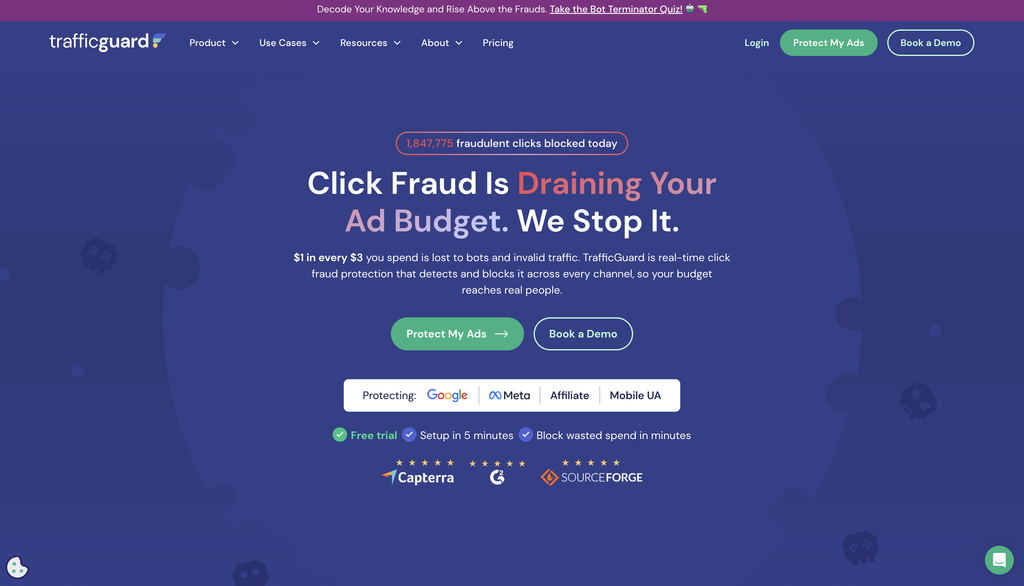
Best for: Larger advertisers, mobile marketers, agencies, and businesses running campaigns across multiple channels.
TrafficGuard is one of the tools I would look at when the advertising environment becomes more complicated than straightforward Google Search campaigns.
The company describes protection across Google Search, Performance Max, Meta, affiliate, and mobile advertising. It also emphasizes real-time analysis, device fingerprinting, and pre-click validation.
That broader scope is its biggest advantage. This broader coverage makes TrafficGuard an appealing click fraud prevention software option for advertisers with more complex acquisition strategies.
How TrafficGuard approaches fraud
TrafficGuard says its system looks at signals such as known fraudulent IPs, malicious sites, data-center traffic, VPN activity, and behavioral anomalies.
Its documentation also describes multiple layers of fraud protection, including click-level detection and analysis of click behavior.
The platform is therefore more than a simple dashboard showing suspicious clicks.
It is designed to actively prevent invalid traffic from reaching campaigns. This makes it a relevant click fraud prevention software option for businesses that need more than basic traffic reporting.
Where I think it fits best
If your entire advertising operation is:
One website + Google Search + modest monthly budget
you may not need the broader functionality.
But if you are managing:
Google + Meta + affiliate + mobile + multiple campaigns
TrafficGuard becomes much more interesting.
Potential drawback
The broader feature set can mean more complexity than a small advertiser needs.
It is also important to understand exactly which protection capabilities apply to each advertising channel because “multi-channel” does not necessarily mean every channel works identically.
My verdict
One of the more compelling options for advertisers who need protection beyond traditional Google Ads.
Rating for practical use: 9/10
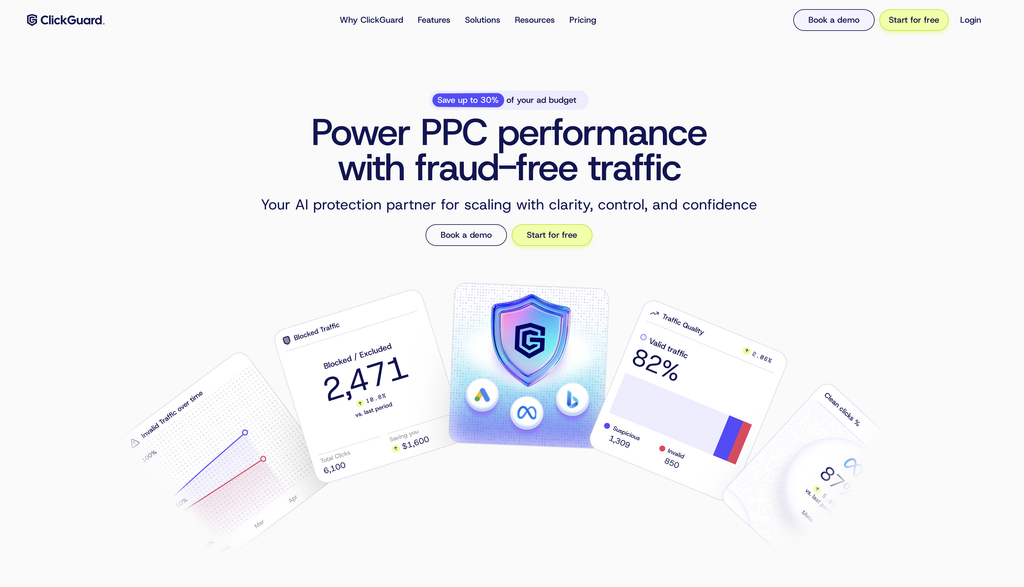
4. ClickGuard: Good for Granular Control
Best for: Advertisers who want detailed controls and campaign-level protection.
ClickGuard takes a more configurable approach.
Its published plans include protection for Google, Meta, and Microsoft Ads, click and behavior tracking, reporting, blacklist management, and progressively more advanced protection controls depending on the plan.
This is important because some marketers don’t want a system that simply says:
“Trust us. We detected fraud.”
They want to understand the rules and have more control over what happens next. That level of control is one of the reasons advertisers may prefer configurable click fraud prevention software over basic traffic monitoring.
What stood out to me
ClickGuard’s pricing is based on advertising spend rather than simply charging for every click.
Its current published pricing starts at $74 per month for a Lite plan covering up to $5,000 in spend, with higher plans adding more websites, reporting, tracking, and protection functionality.
The platform also provides click and behavior tracking.
That makes it an interesting middle ground between a pure fraud blocker and a broader traffic-analysis system.
Potential drawback
The pricing can become significant as advertising spend increases.
I would therefore calculate the expected cost against the amount of potentially wasted spend rather than looking at the monthly subscription in isolation.
My verdict
A good option for advertisers who value control and customization instead of a one-size-fits-all approach.
Rating for practical use: 8.7/10
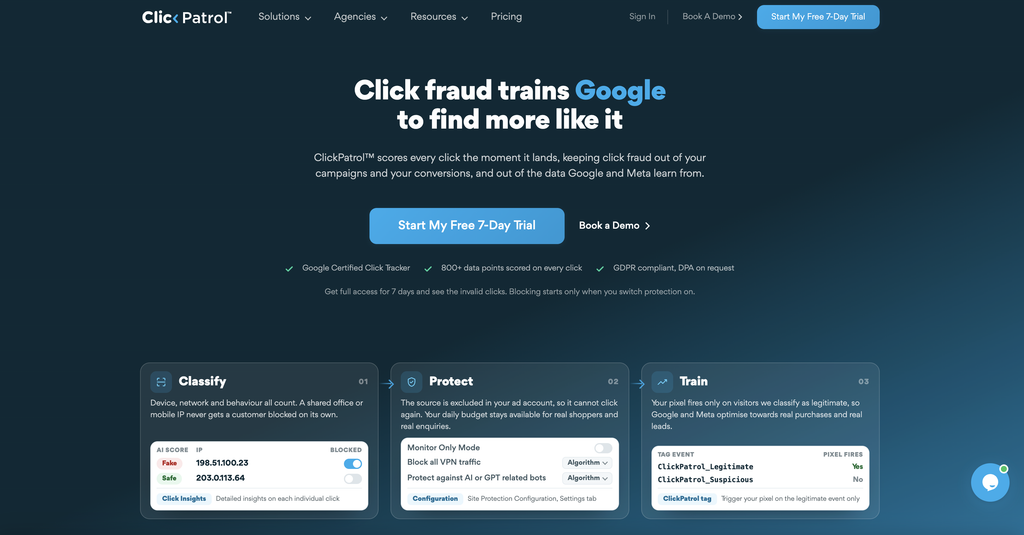
5. ClickPatrol: Interesting Multi-Channel Option
Best for: Advertisers who want broad platform coverage and real-time click scoring.
ClickPatrol is one of the newer names I would put on a serious shortlist.
The company says it analyzes every click across platforms including Google, Meta, Microsoft, Performance Max, TikTok, and LinkedIn. It says its system scores clicks using more than 800 data points and can automatically block invalid sources.
That is a meaningful feature set.
What makes ClickPatrol interesting?
The platform isn’t limited to basic Google Ads protection.
It also emphasizes:
- Bot detection
- Competitor click detection
- Scraper blocking
- VPN and proxy detection
- Form spam protection
- Remarketing audience cleanliness
- Smart Bidding data quality
Those additional capabilities matter because fraudulent traffic doesn’t necessarily stop at the click.
A fake visitor can also become a fake lead, pollute an audience, or influence automated bidding.
Pricing
ClickPatrol currently advertises a free seven-day trial and a Starter plan priced at €71/month, with higher tiers based on protected click volume.
The free trial is useful because it lets a marketer inspect traffic before committing to active blocking. This makes ClickPatrol worth considering for businesses comparing click fraud prevention software before making a longer-term commitment.
Potential drawback
Because the product is relatively newer than some established names, I would spend more time evaluating its reporting and actual results in your own account before moving it into a critical campaign.
My verdict
A compelling option for multi-channel marketers who want detailed click scoring and automated protection.
Rating for practical use: 8.6/10
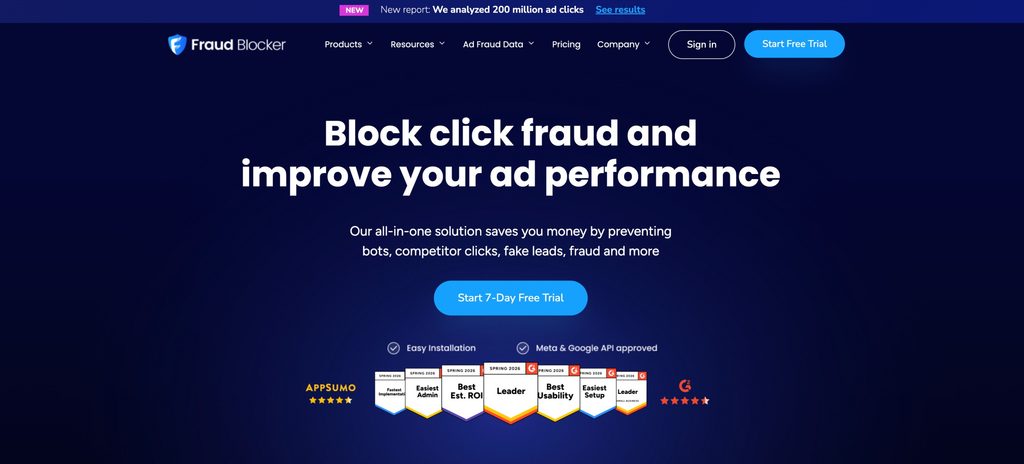
6. Fraud Blocker: Simple and Practical for Smaller Advertisers
Best for: Small businesses and advertisers who want straightforward fraud monitoring.
Fraud Blocker takes a simpler approach than some enterprise-oriented platforms.
Its documented workflow is easy to understand:
- Install the fraud-detection pixel.
- Connect Google Ads or Facebook.
- Let the system analyze incoming traffic.
- Identify fraudulent sources.
- Prevent ads from being shown to those sources.
That simplicity can actually be a strength.
Not every business needs an enormous fraud-management platform.
Sometimes a marketer simply wants to answer:
“Is something suspicious happening to my paid traffic, and can I stop it?”
That is exactly the type of problem click fraud prevention software is designed to help address.
What I like about it
Fraud Blocker explicitly discusses several common sources of bad traffic, including bots, click farms, and competitors.
It also allows IP addresses to be exported so they can be used with other advertising channels.
That can be useful if you want your fraud analysis and advertising-account management to remain somewhat separate.
Potential drawback
Its platform coverage and depth may not be as attractive to an enterprise advertiser running a large, complex, multi-channel acquisition operation.
My verdict
Worth considering if you want a relatively straightforward PPC fraud workflow without excessive complexity.
Rating for practical use: 8.1/10
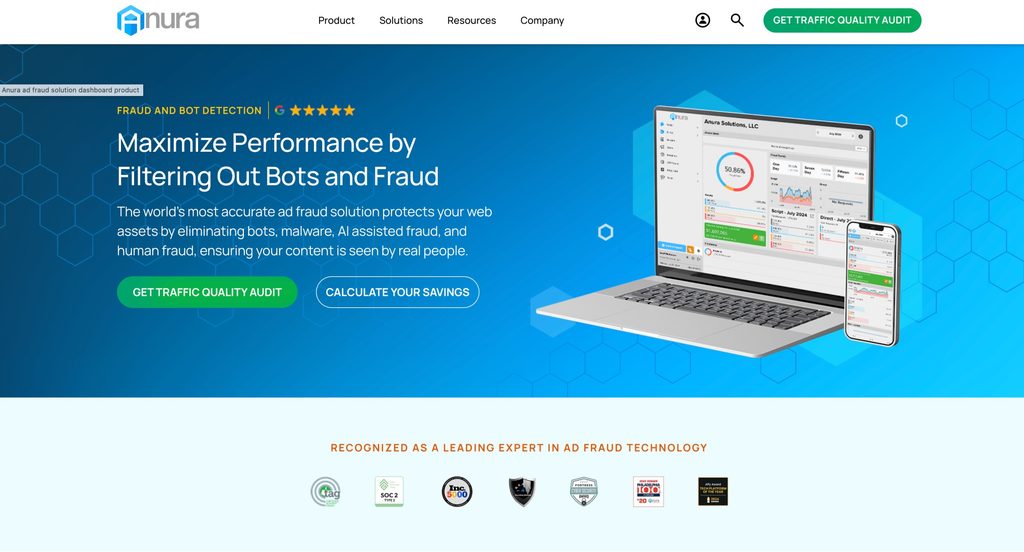
7. Anura: Strong Focus on Traffic Verification
Best for: Advertisers and organizations that need deeper traffic-quality verification.
Anura approaches the problem from a broader ad-fraud detection perspective.
Its Search and Social Protect product says it identifies bots, malware, and human-based fraud such as click-farm activity. It also says fraudulent visitors can be automatically prevented from seeing ads across platforms including Google, Microsoft Ads, Facebook, Instagram, TikTok, YouTube, LinkedIn, and others.
That is a serious scope.
What makes Anura different?
One point I found particularly interesting is its distinction between pre-click and post-click analysis.
Anura says it can examine the environment from which a click originates before the click and then analyze session information after the click.
That matters because fraud is not always obvious from the click itself.
A sophisticated fraudulent visitor can look relatively normal at first.
What I like
Anura focuses heavily on verification rather than simply assigning a generic “bad traffic” label.
The company says its system analyzes many visitor data points and aims to distinguish genuine visitors from fraudulent traffic.
Potential drawback
This is probably more infrastructure than a small advertiser needs.
If you’re spending $1,000 per month on PPC, an enterprise-oriented fraud-detection solution may be difficult to justify.
My verdict
A strong candidate for businesses where traffic quality, fraud verification, and scale justify a more sophisticated system.
Rating for practical use: 8.8/10
8. DataDome Ad Protect: Best for Broader Bot and Ad Fraud Protection
Best for: Larger organizations that care about both advertising fraud and broader bot activity.
DataDome is different from a typical PPC-only tool.
The company operates in the broader bot-management and fraud-prevention space, and its Ad Protect product is designed specifically to address advertising fraud.
DataDome says Ad Protect analyzes campaign traffic in real time and blocks fraudulent activity. Its documentation also explains that its active protection can automatically exclude fraudulent IPs or IP ranges from Google Ads campaigns.
Why I included it
I think it’s useful to include at least one platform that shows how the boundary between click fraud prevention software and broader bot-management technology is becoming less clear.
Modern advertising fraud can involve:
- Bots
- Scrapers
- Automated browsers
- Fake users
- Data-center traffic
- Account abuse
- Click manipulation
A platform that already specializes in identifying malicious automated traffic can therefore have advantages.
Potential drawback
For a normal PPC advertiser, DataDome may be more platform than necessary.
It is better suited to businesses where advertising fraud is part of a larger traffic-security problem.
My verdict
Very interesting for larger businesses, but probably overkill for a small PPC account.
Rating for practical use: 8.5/10
9. CHEQ Essentials: Strong Enterprise and Marketing-Focused Option
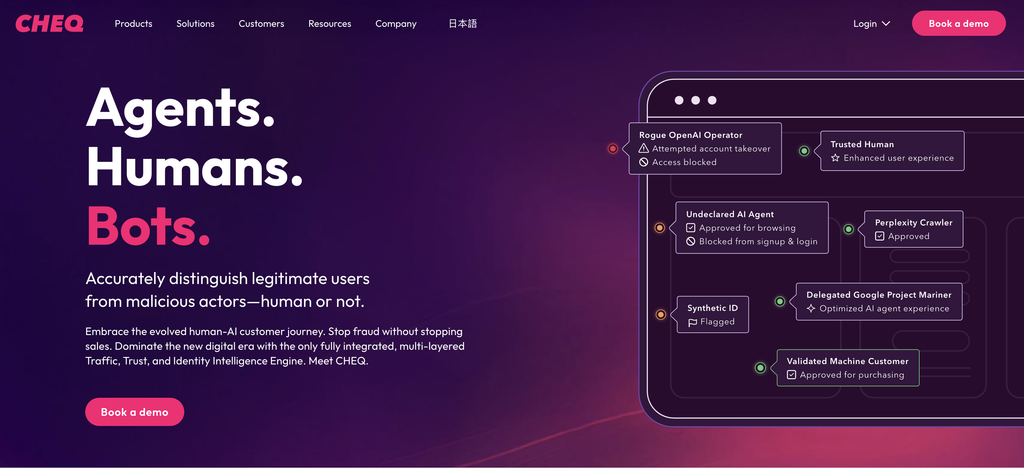
Best for: Marketing teams that want fraud protection tied closely to campaign and audience quality.
CHEQ has been active in the PPC fraud space for years, and its content and product ecosystem focus heavily on invalid traffic, paid media, and marketing protection.
CHEQ’s published material describes protection across major paid advertising platforms and the use of machine learning to identify invalid clicks and exclude fraudulent audiences.
One reason I think CHEQ deserves consideration is that it looks beyond the narrow definition of “somebody clicked my ad.”
For example, fraudulent traffic can contaminate remarketing audiences.
That means the damage can continue even after the original click.
CHEQ has documented examples where invalid traffic was identified and excluded from remarketing audiences.
What I like
The marketing-first approach makes sense.
A PPC manager usually doesn’t care about fraud as an abstract cybersecurity statistic.
They care about:
“Is my campaign learning from the wrong people?”
“Are my audiences polluted?”
“Am I paying salespeople to follow up with fake leads?”
“Is my conversion data trustworthy?”
Those are much more useful questions.
Potential drawback
CHEQ is more enterprise-oriented than a basic click-blocking utility.
Setup can also involve tags and implementation steps, so I would expect more involvement from a marketing operations or technical team.
My verdict
A strong option for organizations where paid media quality, audience quality, and broader marketing security overlap.
Rating for practical use: 8.7/10
10. fraud0: Interesting for Prevention Plus Ad-Spend Recovery
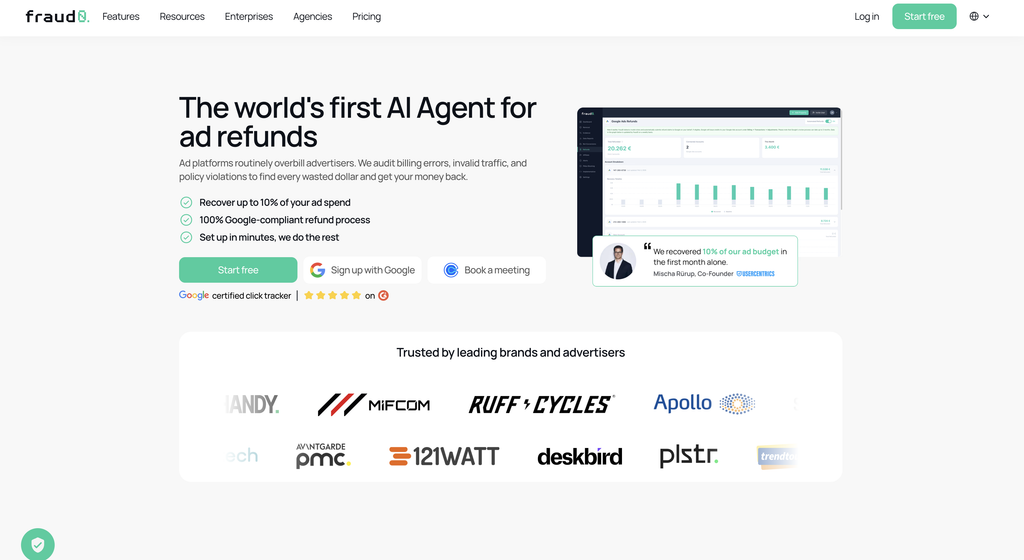
Best for: Advertisers interested in both preventing invalid traffic and documenting potentially recoverable ad spend.
fraud0 is particularly interesting because its current positioning goes beyond simple click blocking.
Its platform describes detection of sophisticated invalid activity, geo and targeting validation, automatic exclusion of fake users, and placement blocking.
It also emphasizes evidence and ad-spend recovery.
That is a different angle from some of the other tools on this list.
Why that matters
There are really two problems:
Problem 1: Stop future waste.
Problem 2: Figure out what happened to money you already spent.
fraud0 is trying to address both.
Its current materials explain that advertisers can detect invalid activity, document it, and use evidence as part of a recovery process.
I think that is useful because prevention isn’t always perfect.
No serious fraud system should imply that every fraudulent click can be identified before it happens.
fraud0 itself makes an important point in its current Google Ads guidance: you cannot necessarily pre-block every new fraudulent visitor because a brand-new source may not have an existing history or signal.
That is a more realistic way to think about fraud prevention.
Potential drawback
Its current product positioning around refund recovery means you need to understand the pricing model and recovery terms carefully.
My verdict
An interesting choice if recovery evidence is as important to you as ongoing traffic protection.
Rating for practical use: 8.4/10
Quick Comparison: 10 Click Fraud Prevention Software Tools
Here is how I would summarize the list for a marketer who doesn’t want to read every review.
| Tool | Best suited for | Main strength | Multi-platform | My take |
|---|---|---|---|---|
| ClickCease | SMBs/agencies | Behavioral fraud detection | Yes | Strong all-around choice |
| Lunio | Performance marketers | AI/ML traffic analysis | Yes | Excellent for traffic quality |
| TrafficGuard | Larger advertisers | Cross-channel + mobile | Yes | Strong for complex campaigns |
| ClickGuard | PPC managers | Granular controls | Yes | Good customization |
| ClickPatrol | Multi-channel advertisers | Real-time click scoring | Yes | Promising modern option |
| Fraud Blocker | Smaller advertisers | Simple workflow | Limited | Easy to understand |
| Anura | Enterprise advertisers | Traffic verification | Yes | Sophisticated approach |
| DataDome | Larger organizations | Bot + ad fraud | Yes | Powerful but potentially overkill |
| CHEQ Essentials | Marketing teams | PPC + audience protection | Yes | Strong enterprise option |
| fraud0 | Recovery-focused advertisers | Prevention + evidence | Yes | Interesting hybrid approach |
The important thing is that there isn’t one universal winner. The right click fraud prevention software ultimately depends on your specific advertising setup and traffic risks.
The best click fraud software for a $2,000/month Google Ads account is not necessarily the best product for a company spending $500,000/month across Google, Meta, affiliate, and mobile.
Get More Visibility Into Your Ad Clicks
Connect your campaigns with Linkstrackly and understand which links, sources, and campaigns drive your clicks, helping you investigate suspicious patterns with greater confidence.
What Are the Biggest Click Fraud Prevention Software Benefits?
Before paying for a dedicated platform, I think it’s worth understanding what you’re actually buying.
The most obvious benefit is wasted-spend reduction.
But that is only one piece. Good click fraud prevention software should also help marketers understand what is happening to their traffic.
1. Better visibility into traffic quality
Without additional monitoring, your ad platform may tell you that you received 1,000 clicks.
A dedicated fraud system can help answer:
- How many appeared suspicious?
- Where did they originate?
- What devices were involved?
- What behavior did they exhibit?
- Which campaigns were affected?
- Which traffic sources produced the problem?
That additional visibility can be valuable even before you block anything.
2. Cleaner conversion data
Suppose bots repeatedly visit your landing page and trigger events.
Your analytics system may record activity.
Your advertising platform may also receive signals.
If enough poor-quality activity enters the system, automated bidding and audience-building can become less useful.
That is why good click fraud prevention isn’t only about saving money. Effective click fraud prevention software can also help marketers maintain more reliable campaign data.
It can also be about protecting the quality of your marketing data.
3. Faster investigation
Imagine seeing a sudden 70% drop in conversion rate.
Without detailed traffic information, you may spend hours changing campaigns.
With better click and visitor information, you may discover that the traffic changed dramatically during the same period.
That doesn’t prove fraud by itself, but it gives you a much better starting point.
4. Reduced manual blocking
Manually reviewing IP addresses and maintaining exclusion lists can become painful.
Automation is one of the most practical reasons to use dedicated click fraud prevention software.
5. Cleaner remarketing audiences
Bad traffic doesn’t necessarily disappear after the click.
If suspicious visitors are added to remarketing audiences, you can end up spending more money advertising to people who were never genuine prospects.
Some platforms specifically address this problem.
Is It Click Fraud Prevention Software or Just Click Tracking?
This is where I think marketers should be careful.
A product can provide excellent click tracking without being a fraud-prevention product.
For example, a tracking system might show:
500 clicks
80 clicks from one source
45 clicks from a specific campaign
30 clicks from an unusual location
That is useful information.
But the software hasn’t necessarily stopped anything.
It has given you visibility.
And honestly, visibility is extremely important.
You cannot investigate what you cannot see.
This is exactly where I see an opportunity for Linkstrackly.
How Linkstrackly Fits Into Click Fraud Prevention
I would not position Linkstrackly as a replacement for every dedicated fraud-prevention platform.
That would be the wrong message.
Instead, I would position it as a click-tracking and visibility layer that can help marketers understand the traffic behind their campaigns.
Think about the workflow like this:
Ad → Linkstrackly tracking link → Click data → Traffic pattern → Investigation → Campaign decision
That is a very practical role.
Step 1: Create a trackable link
Suppose I am running a paid campaign.
Instead of treating every destination URL as an anonymous click destination, I can create a trackable link for the relevant campaign, ad, placement, or traffic source.
That gives me a measurement point.
Step 2: Send traffic through the tracked link
Now the traffic has a connection to the campaign or source I want to analyze.
This becomes particularly useful when I have multiple acquisition channels.
Step 3: Look at the click activity
This is where a tracking platform such as Linkstrackly becomes useful.
Instead of looking only at total campaign clicks, I can start asking:
- Where are the clicks coming from?
- Which campaign is producing them?
- Is one link behaving differently?
- Did click volume suddenly spike?
- Does the traffic pattern look normal?
- Are the clicks producing meaningful outcomes?
Step 4: Investigate abnormal patterns
Let’s use a hypothetical campaign.
Imagine I receive:
- 500 total clicks
- 80 clicks from one unusual source
- Repeated activity showing an abnormal pattern
- Very little meaningful engagement
- Almost no conversions
I wouldn’t automatically label all 80 clicks as fraudulent.
That would be irresponsible.
Instead, I would flag the source for investigation.
That distinction is important.
Suspicious does not always mean fraudulent.
Step 5: Take action
Once I have enough evidence, I can decide what to do.
Depending on the advertising platform and fraud-prevention setup, that might mean:
- Adjusting targeting
- Reviewing placements
- Excluding problematic sources
- Blocking known bad traffic
- Changing campaign settings
- Investigating competitors
- Reviewing the landing page
- Connecting dedicated fraud-prevention software
This is where tracking and prevention work together.
Why Linkstrackly Is Useful Even If You Already Use Fraud Protection
This is probably the most important point for Linkstrackly.
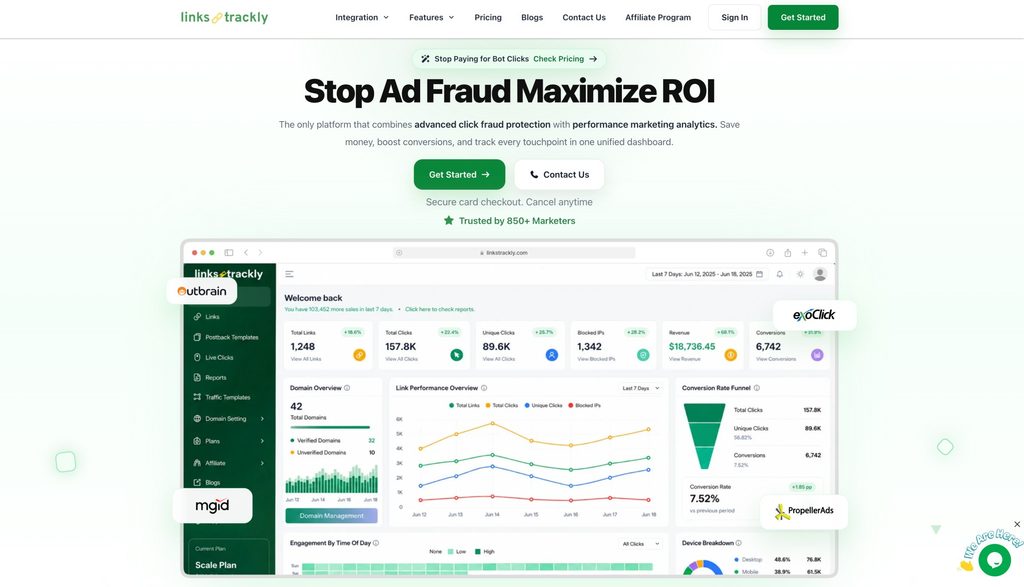
A fraud-prevention tool may tell you:
“We detected invalid traffic.”
But marketers often need another question answered:
“Where did that traffic come from?”
A click-tracking platform can help provide the campaign context around that activity. When combined with click fraud prevention software, this additional campaign context can make suspicious traffic easier to investigate.
Think about the difference.
Fraud platform
“This visitor looks suspicious.”
Tracking platform
“This click came through Campaign A, Ad B, Source C, and this specific tracking link.”
Together
You get:
“This suspicious traffic is associated with this campaign/source, so I know where to investigate first.”
That is a much more useful workflow.
So I would use Linkstrackly as a measurement and investigation layer, while a specialized fraud platform can provide automated detection and blocking where needed.
That positioning is more credible than claiming a tracking platform alone can eliminate click fraud.
Can Click Tracking Alone Prevent Click Fraud?
No, not necessarily.
This is one of the most important conclusions I reached while researching these tools.
Tracking is not automatically prevention. This distinction is particularly important when comparing click-tracking platforms with dedicated click fraud prevention software.
A tracking system can help you see patterns, but actual prevention may require:
- Automated exclusions
- IP blocking
- Audience exclusions
- Device or behavior analysis
- Advertising-platform integrations
- Fraud scoring
- Bot detection
- Campaign rules
- Human review
That means I would not choose a click-tracking platform simply because it has a lot of analytics and assume it provides full fraud protection.
Instead, ask:
What happens after the software identifies suspicious activity?
Does it only report it?
Does it recommend an action?
Does it automatically exclude the source?
Does it update the advertising platform?
Does it prevent conversion events from being polluted?
Those answers tell you much more about the real value of the product.
How to Choose the Right Click Fraud Prevention Software
After looking across these platforms, I would use a fairly simple buying process. Choosing click fraud prevention software becomes much easier when you first understand your traffic, budget, and advertising channels.
1. Start with your advertising spend
If you’re spending $1,000 per month, a $500/month fraud platform may be difficult to justify.
If you’re spending $100,000 per month, a few hundred dollars for additional protection can be much easier to justify. This is why the cost of click fraud prevention software should always be compared with the potential cost of invalid traffic.
Always evaluate the software cost against the potential waste and data-quality impact, not just the subscription price.
2. Check your advertising platforms
Do you only use Google Ads?
Or do you also use:
- Meta
- Microsoft
- TikTok
- Performance Max
- Affiliate networks
- Mobile advertising
Choose a product that actually supports the channels that matter to you.
3. Look at what “blocking” actually means
This is an important one.
“Fraud detected” and “fraud prevented” are not the same thing.
Ask how the platform responds after detection.
4. Check what data you can see
I prefer systems that let marketers investigate.
A black-box score can be useful, but detailed evidence is better when you’re trying to understand why a campaign is behaving strangely.
5. Look at implementation
Some platforms require tags, pixels, integrations, or technical setup.
Others emphasize quick account connections.
Neither is automatically better.
It depends on your team.
6. Don’t blindly trust accuracy percentages
You will notice that some vendors publish extremely impressive accuracy figures.
That’s useful information, but remember:
Vendor-reported accuracy is still a vendor claim.
Different vendors can define fraud, invalid traffic, detection, and accuracy differently.
I would therefore treat those numbers as one input—not the final buying decision.
When Should I Use Click Fraud Prevention Software?
The answer depends on your risk.
I would seriously consider dedicated protection when:
- Your PPC budget is large enough that wasted clicks are financially meaningful.
- You operate in a high-CPC industry.
- You have noticed suspicious traffic spikes.
- Click volume is increasing while conversions aren’t.
- You frequently see traffic from unexpected locations.
- Your campaigns are repeatedly targeted by competitors.
- Your remarketing audiences appear unusually low quality.
- Your analytics data contains unexplained traffic anomalies.
- You manage paid campaigns for multiple clients.
- You run campaigns across multiple advertising networks.
For very small campaigns, manual monitoring may be enough at first.
But as spend increases, the economics change.
Should I Use Click Fraud Prevention Software?
If you’re asking “should I use click fraud prevention software?”, I would not answer with an automatic yes. Instead, evaluate whether click fraud prevention software would provide enough financial and operational value for your campaigns.
I would ask three questions first.
Question 1: How much are you spending?
If your monthly advertising spend is substantial, even a relatively small percentage of invalid traffic can become expensive.
Question 2: Do you have evidence of suspicious traffic?
Look at:
- Click spikes
- Conversion-rate changes
- Geographic anomalies
- Unusual devices
- Repeat activity
- Traffic-source changes
- Low-quality sessions
- Suspicious placements
Question 3: What happens if the traffic continues?
If the answer is “we could waste thousands of dollars before noticing,” dedicated protection becomes much easier to justify.
In other words, click fraud prevention software is most valuable when the potential cost of doing nothing is greater than the cost and complexity of adding protection.
My Final Ranking
After comparing the 10 tools, this is how I would group them rather than pretending there is one universal winner.
Best overall for many PPC advertisers: ClickCease
It has a mature feature set, established positioning, broad paid-platform coverage, and automated protection.
Best for performance marketers: Lunio
I like its emphasis on traffic quality, machine-learning analysis, click analytics, and automatic exclusions.
Best for complex multi-channel campaigns: TrafficGuard
Its cross-channel and mobile capabilities make it particularly interesting for larger advertising operations.
Best for control: ClickGuard
A good fit when detailed configuration and protection controls matter.
Best emerging multi-channel option: ClickPatrol
Its broad platform coverage and real-time click scoring make it worth watching closely.
Best simple option: Fraud Blocker
Its workflow is straightforward and easier to understand for smaller advertisers.
Best for sophisticated traffic verification: Anura
A strong option when traffic-quality verification is a serious business requirement.
Best for broader bot protection: DataDome
More powerful than many PPC-only tools, although that can also make it excessive for smaller advertisers.
Best for marketing teams: CHEQ Essentials
A strong choice when fraud prevention overlaps with audience, conversion, and marketing-data quality.
Best for prevention plus recovery: fraud0
Interesting if documenting invalid traffic and recovering potentially wasted ad spend are important parts of your workflow.
Turn Click Data Into Actionable Insights
See where your clicks come from, identify unusual campaign activity, and use clearer tracking data to investigate questionable traffic with Linkstrackly before optimizing campaigns.
So, What Actually Works?
After researching these tools, my biggest takeaway is that click fraud prevention software is not magic. The best click fraud prevention software should therefore be viewed as one part of a broader system for monitoring, analyzing, and protecting paid traffic.
No serious marketer should expect a piece of software to perfectly identify every fraudulent click before it happens.
Fraud changes.
Attackers adapt.
New devices appear.
VPNs and proxies change.
Bots become more sophisticated.
Legitimate users can also look unusual.
That means the strongest approach is layered.
I would think about it this way:
Advertising platform protection + fraud detection + click tracking + campaign monitoring + human investigation = stronger traffic protection.
Dedicated fraud tools are useful because they automate detection and prevention.
Click tracking is useful because it gives you visibility into what happened.
And this is where I think Linkstrackly can fit naturally.
If I am using Linkstrackly to track my campaigns, I can create a clearer connection between the advertisement, tracking link, traffic source, and resulting click activity.
That gives me something valuable even when I use a separate fraud-prevention platform.
I can ask:
“Which campaign generated this traffic?”
“Which link was involved?”
“Did the click volume suddenly change?”
“Which source deserves further investigation?”
“Is this traffic actually producing business results?”
Those are practical questions—not just fraud scores.
The goal isn’t to block every unusual visitor.
The goal is to spend advertising money on traffic that has a realistic chance of becoming a customer and have enough data to investigate the traffic that doesn’t.
So, if you’re evaluating click fraud prevention software, I would start with the tools above, compare their actual coverage against your advertising stack, and use a tracking layer such as Linkstrackly to maintain visibility into your click activity.
That combination is much more useful than blindly trusting a single “fraud detected” number. Ultimately, the best click fraud prevention software is the solution that fits your budget, advertising channels, traffic volume, and level of required protection.
FAQs
1. What is click fraud prevention software?
Click fraud prevention software is a type of marketing technology designed to identify suspicious, fraudulent, or invalid interactions with paid advertisements and help prevent those interactions from wasting advertising budget. Depending on the platform, it may analyze IP addresses, devices, behavior, traffic sources, geographic information, and other signals before taking action.
2. How does click fraud prevention software work?
Most platforms use multiple signals rather than relying on one factor. A system may analyze a visitor’s technical environment, behavior, traffic source, click frequency, location, device, and other characteristics. If the activity meets the platform’s fraud criteria, the system may flag, exclude, block, or otherwise prevent the source from continuing to interact with advertising campaigns.
3. What is the best click fraud software?
There is no single best option for every advertiser. ClickCease, Lunio, TrafficGuard, ClickGuard, ClickPatrol, Fraud Blocker, Anura, DataDome, CHEQ Essentials, and fraud0 all approach the problem somewhat differently. Your best choice depends on advertising platforms, monthly spend, desired automation, reporting requirements, and whether you need prevention, detection, recovery, or a combination.
4. Does Google Ads already prevent click fraud?
Google has its own systems for detecting and filtering invalid activity, so third-party protection is not automatically required for every advertiser. However, advertisers may still use additional monitoring and fraud-prevention systems when they need greater visibility, cross-channel protection, or additional controls. TrafficGuard, for example, describes its service as an additional layer over Google’s own invalid-traffic protection.
5. What is pay per click fraud prevention software?
Pay per click fraud prevention software is designed specifically to help protect PPC campaigns from invalid clicks and other forms of fraudulent or low-quality paid traffic. It can be particularly useful when a business pays for every click and operates campaigns where even a relatively small amount of wasted traffic can materially affect acquisition costs.
6. Can click tracking prevent click fraud?
Click tracking alone does not necessarily prevent fraud. Tracking can provide the visibility needed to identify unusual sources, click patterns, campaigns, or traffic behavior. Dedicated fraud-prevention products may then use additional detection and blocking mechanisms to act on that information. This is why I see Linkstrackly as a useful tracking and investigation layer rather than automatically positioning it as a replacement for specialized fraud-detection systems.
7. What are the main click fraud prevention software benefits?
The main benefits can include better visibility into suspicious traffic, reduced wasted advertising spend, cleaner conversion data, improved campaign analysis, reduced manual monitoring, and cleaner remarketing audiences. The exact benefits depend on the product and how it integrates with your advertising platforms.
8. How can I identify fraudulent clicks?
Look for patterns rather than assuming one unusual click is fraudulent. Useful warning signs can include sudden click spikes, repeated activity, unusual geographic traffic, suspicious device or network patterns, high click volume with very low conversion activity, unexpected traffic sources, and changes in traffic quality. A dedicated platform can automate much of this analysis.
9. Is it click fraud prevention software if it only reports suspicious traffic?
I would call that click fraud detection or monitoring software, not full prevention software, unless it also provides a mechanism for acting on the detected traffic. Reporting can be extremely useful, but prevention generally implies that the system can help stop, exclude, or mitigate future fraudulent activity.
10. Should I use click fraud prevention software?
If you’re spending enough on paid advertising that suspicious traffic could have a meaningful financial impact, it is worth evaluating. I would first review your traffic data and determine whether there are signs of invalid activity. Then compare the likely cost of wasted spend with the subscription and implementation cost of a dedicated solution. For smaller campaigns, detailed click tracking and regular monitoring may be sufficient; for larger campaigns, automated protection can become much more valuable.